Why Netanyahu is Slipping in the Polls
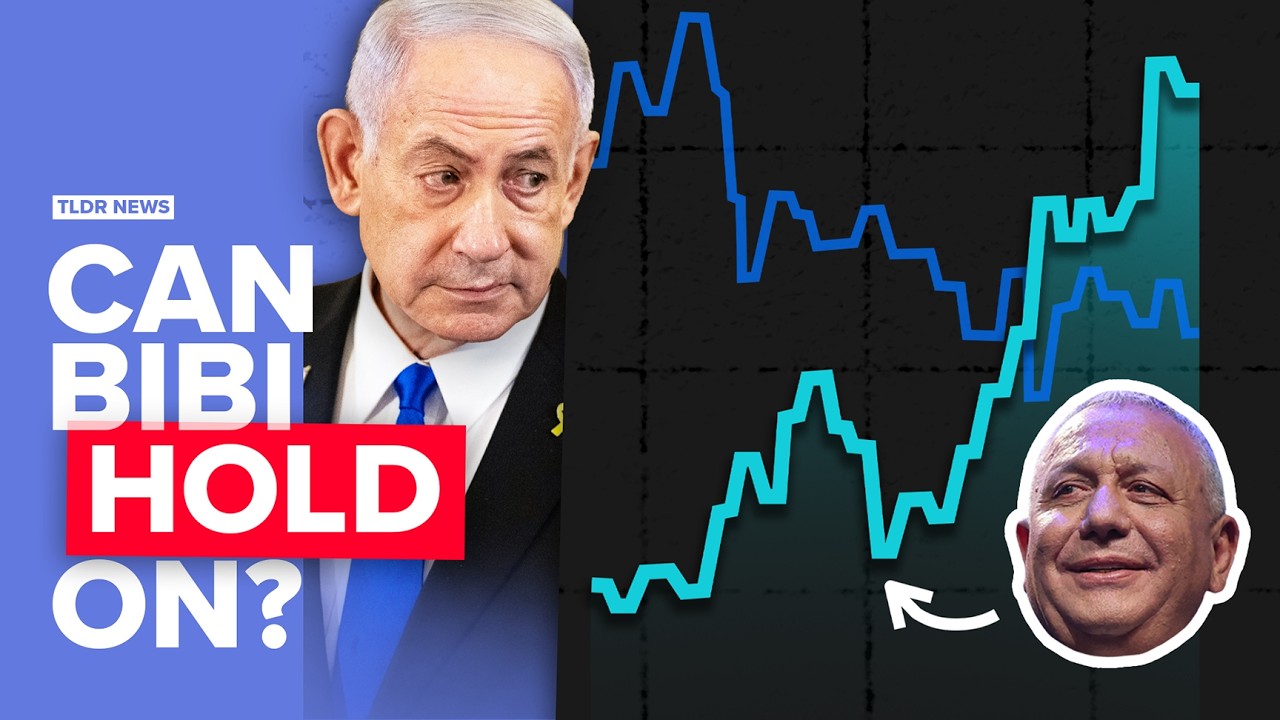
The creator reports that Israel will hold its first national election since the October 7, 2023 Hamas attack and Netanyahu's subsequent wars in Gaza, Lebanon, and Iran, with voting set for October 27, 2026, under a backdrop of a coalition fight over a law halting ultra-Orthodox military enlistment and Netanyahu's refusal to allow an independent inquiry into October 7 failures. Former IDF chief of staff Gadi Eisenkot, who left Netanyahu's war cabinet over disputes about the war and formed his own party Yashar, formally declared his bid to succeed Netanyahu on June 30, 2026, and recent polls plus a Polymarket figure shown on screen (52.8% to Netanyahu's 34%) point to him as the frontrunner. The creator argues this makes the vote one of the messiest and most consequential in Israel's history, framing Netanyahu's October 7 record and coalition tensions as his central vulnerabilities, a reading attributed to the creator rather than confirmed independently.
Confirmed: Israelis will vote on October 27, 2026, the first national election since the October 7, 2023 Hamas attack and since Netanyahu expanded wars into Gaza, Lebanon, and Iran.
- Confirmed: Israel's Knesset has 120 seats, elections are meant to occur every four years, and few governments finish a full term.
- Confirmed: Knesset seats are allocated by proportional representation to party lists that clear a 3.25% threshold, equal to four seats, and no party has ever won an outright majority.
- Confirmed: Netanyahu's coalition, formed in 2022 with Likud, Bezalel Smotrich's Religious Zionism, and Itamar Ben-Gvir's Jewish Power, is described as the most right-wing government in Israel's history.
- Confirmed: a few weeks before the election, Israel's parliament passed laws halting enlistment of ultra-Orthodox men into the military despite existing troop shortages and public frustration.
+ 17 more takeaways
- Confirmed: Netanyahu has blocked creation of an independent state commission to investigate the failures behind October 7 and instead proposed a politician-appointed commission.
- Confirmed [03:37]: Gadi Eisenkot served in the IDF more than 40 years, entered politics in 2022 with the centre-right National Unity Party, and was elected to the Knesset that year.
- Confirmed [03:49]: after October 7, National Unity joined Netanyahu's emergency government and Eisenkot took a seat in the war cabinet, but he left a year later over disagreements on Netanyahu's handling of the war and formed his own party, Yashar.
- Confirmed [04:12]: Eisenkot formally declared his intention to succeed Netanyahu as PM on June 30, 2026; before that, Netanyahu's main opposition was Yair Lapid and Naftali Bennett, who had combined forces to try to overtake Likud.
- Confirmed [04:40]: recent opinion polls put Yashar among Israel's leading parties, with some surveys ahead of Likud, and suggest opposition parties could have enough seats to form a governing coalition.
- Source cited [04:40]: Polymarket, shown on screen, has Eisenkot as favourite for next PM at 52.8%, versus Netanyahu 34%, Bennett 7%, and Avigdor Lieberman 4.1%.
- Confirmed [05:23]: Eisenkot has vowed to repeal the ultra-Orthodox military exemption law and called for an independent state commission of inquiry into October 7 failures, which Netanyahu has refused to allow.
- Confirmed [05:55]: Eisenkot has distanced himself from Palestinian statehood, favouring continued control over parts of the occupied West Bank while opposing full annexation.
- Confirmed [06:10]: Eisenkot pioneered Israel's strategy of disproportionate military responses in Lebanon while head of the IDF.
- Confirmed [06:25]: Netanyahu posted an AI-generated video showing Eisenkot running past an Israeli-unity-shirt-wearing man to embrace Mansour Abbas, an Arab-Israeli lawmaker heading an Islamic party, as part of an effort to portray Eisenkot's party as pro-Arab.
- Confirmed [06:50]: the man ignored in Netanyahu's AI-generated video bears a resemblance to Eisenkot's 25-year-old son, who was killed during the Gaza war as an army reservist.
- Take (creator) [03:11]: the creator argues that despite Israel expanding the war into southern Lebanon, parts of Syria, and strikes on Iran and Yemen's Houthis, the country still isn't in a better security position.
- Take (creator): the creator frames Netanyahu's key electoral weaknesses as intra-coalition tension over ultra-Orthodox enlistment and his handling of and association with October 7.
- Take (creator) [05:45]: the creator attributes Eisenkot's credibility to challenge Netanyahu to his standing as a celebrated former IDF general.
- Take (creator) [07:09]: the creator characterizes the upcoming election as expected to be one of the messiest and most crucial in Israel's history.
- Open question: the source does not state whether the AI-generated video controversy has had any confirmed effect on Netanyahu's or Eisenkot's standing.
- Big or small, your difference matters, and you can contribute as little as $6 a month to help protect nature and give back to the planet that we all share.
How this brief was shaped: News Analysis / Commentary · confidence Medium
Transcript lays out confirmed facts (election date, Knesset rules, ultra-Orthodox conscription law, October 7th) then pivots to the creator's own read on how these hurt Netanyahu's polling position, and OCR shows a poll-tracker chart alongside a Polymarket prediction market on the next PM, reinforcing a facts-plus-analysis structure.
The lens sets this brief's structure, never its facts — every claim is held to the same citation and fact-check standard.