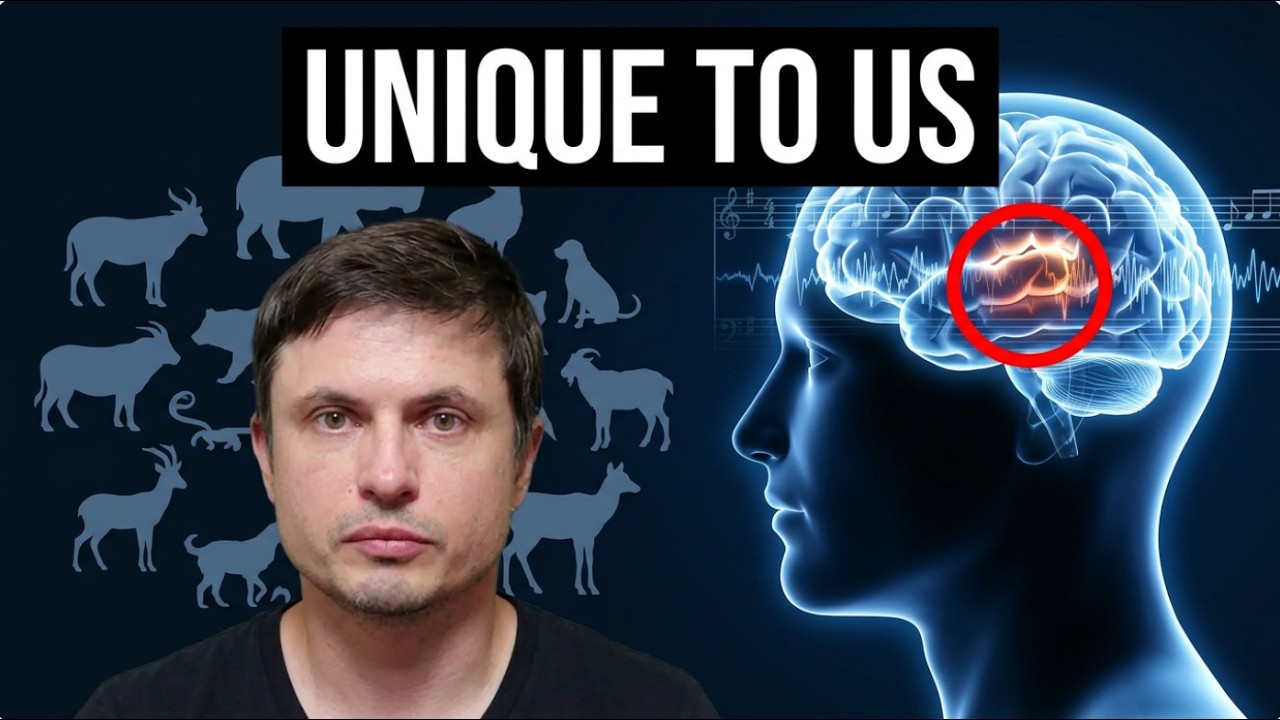
New Study Reveals Why Music Is Uniquely Human
This video covers the neuroscience and evolutionary biology of musical beat perception, the ability to extract a regular pulse from rhythm that underlies tapping, dancing, and group music-making. No speaker credentials, course, or institution are stated for the video itself; it is built around a cited July 2026 paper, "Critical Review on the Development and Evolution of Beat Perception" by Gabor Haden and Henkjan Honing, and walks through newborn EEG studies, the brain's ASAP (Action Simulation for Auditory Prediction) hypothesis, and comparisons across macaques, cockatoos, sea lions, and whales. It closes on the authors' new Gradual Audio-Motor Evolution Reward Hypothesis, which frames beat perception as having developed gradually through a dopamine-linked reward system rather than a single mutation. The video's stated synthesis is that this hardwired, rewarding rhythm system is universal to humans in a way other animals lack, summarized as "music makes us human."
Concept [00:00:00]: The video's main topic is "the hidden science of music" in the human brain, including everyday musical abilities like tapping a foot or bopping a head that most humans perform with little effort.
- Comparative example [00:00:00]: A sea lion named Ronin at UC Santa Cruz can keep a beat, shown performing head bobs in sync with a musical beat.
- Concept [00:00:00]: The video states that beat-keeping, easy for humans, appears to be pretty rare among other animals.
- Concept [00:00:00]: Scientists for a long time believed musicality might be an entirely human property, essentially a clever human invention.
- Named study/source [00:00:00]: The video is based on a July 2026 paper, "Critical Review on the Development and Evolution of Beat Perception," by Gabor Haden and Henkjan Honing.
+ 44 more takeaways
- Concept [00:00:00]: The paper defines beat perception as the ability to extract a regular pulse from rhythmic sequences, described as a foundational component of human musicality supporting synchronization, dance, and collective music-making.
- Named study/source [00:00:00]: The authors are affiliated with the Institute of Cognitive Neuroscience and Psychology (HUN-REN Research Centre for Natural Sciences, Budapest) and the Music Cognition Group at the University of Amsterdam.
- Concept [00:00:00]: The video states it will cover recent neuroscience and evolutionary biology findings, newborn studies, and studies on various animals.
- Named study/source [01:30]: The video states research cited in its description shows the human brain comes pre-equipped at birth with "blueprints" for the concept of music.
- Mechanism [01:43]: This claim is based on studies of human newborns, some only two to three days old.
- Mechanism [01:50]: Researchers used EEG to play rhythmic sounds to sleeping infants to test their sound dispositions.
- Mechanism [02:04]: When a note was occasionally omitted from a regular beat, even the sleeping infants' brains generated a specific electrical response called a "mismatch" response.
- Concept [02:18]: The video states this confirms the newborn brain actively predicts periodic temporal structures from birth, rather than simply learning the sequential order of sounds.
- Concept [02:59]: Many researchers have long hypothesized musicality was a byproduct of language, essentially "speech with extra decoration."
- Comparative example [03:31]: Patients with language-area brain damage can develop aphasia (losing the ability to speak or comprehend words) yet can still sing with perfect pitch and beat.
- Comparative example [03:47]: People born with congenital amusia cannot hear pitch or maintain rhythm despite having normal speech, which the video takes as showing music and language rely on independent neural pathways.
- Concept [04:13]: The video states evidence suggests the neural mechanisms supporting musical rhythm may predate the evolutionary emergence of human language.
- Why it matters [04:21]: This leads to the suggestion that humans might have been able to sing before they could speak.
- Mechanism [04:40]: Listening to a song causes the brain's motor system to light up dramatically, even without any physical movement.
- Mechanism [04:50]: Regions including the premotor cortex, supplementary motor area, and basal ganglia, which plan and execute physical movement, become extremely active during passive listening.
- Named study/source [05:08]: Neuroscientists propose the ASAP hypothesis (Action Simulation for Auditory Prediction) to explain this motor activation during listening.
- Mechanism [05:16]: Human movements like walking or swinging arms typically occur on a time scale of about 100 milliseconds, and the brain's motor planning systems simulate these periodic movements because they happen so often.
- Mechanism [05:49]: Researchers found neural oscillations in the beta frequency range (about 20 to 30 Hz) are closely linked to motor planning and anticipation of upcoming musical beats.
- Mechanism [06:34]: The video states the brain uses internal clocks to predict activity before it happens, describing it as a kind of "time travel simulator."
- Mechanism [06:43]: Because the brain predicts the exact millisecond a beat will occur, it hears those sounds better and reacts to musical notes with more precision.
- Comparative example [07:25]: Macaques can be trained to maintain a beat and match a tempo, but only with rewards and constant supervision.
- Comparative example [07:37]: Macaques seem to lack these beat-keeping traits naturally and cannot maintain a beat unless taught.
- Comparative example [07:43]: Even trained macaques consistently fail in precision, often producing beats slightly delayed or slightly too quick.
- Mechanism [07:53]: The video states this shows macaques are not predicting beats like humans do, but are synchronizing by first hearing the sound and then performing the motion.
- Named study/source [08:20]: Researchers studying a California sea lion named Ronan confirmed rhythmic synchronization exists in animals other than primates.
- Comparative example [08:31]: Parrots and cockatoos can spontaneously synchronize with beats by bopping their head, with a famous example being a cockatoo named Snowball, who went viral in 2007 bopping to the Backstreet Boys' "Everybody" in a video posted by Bird Lovers Only Rescue Services.
- Concept [08:59]: This led to the Vocal Learning and Rhythmic Synchronization Hypothesis, the idea that beat perception developed as a byproduct of vocal mimicry.
- Comparative example [08:59]: The video notes sea lions, which do not mimic vocally, successfully synchronize head bobs to songs, taken as proof that animals without vocal mimicry can still possess the neural machinery for musical perception.
- Comparative example [09:40]: Humpback whales can produce highly complex vocal songs lasting several minutes with hierarchical structure, including individual notes and entire phrases.
- Comparative example [09:58]: These whale songs evolve gradually over months or even years.
- Named study/source [10:30]: Researchers Gabor Haden and Henkjan Honing propose a new hypothesis called the Gradual Audio-Motor Evolution Reward Hypothesis.
- Concept [10:38]: The hypothesis argues human beat perception did not arise from a single lucky mutation but developed gradually as neural pathways between the auditory cortex and motor planning areas strengthened over time.
- Concept [10:57]: The key difference from earlier proposals, per the video, is the integration of a reward mechanism.
- Comparative example [11:03]: Monkeys require extensive external training and food rewards to perform rhythmic tapping and often show signs of frustration.
- Mechanism [11:13]: In humans, auditory-motor circuits appear to be directly linked via a dopamine-based reward system, making synchronizing movement to a beat intrinsically rewarding.
- Named study/source [10:17]: A study referenced in the video found the cockatoo Snowball (Cacatua galerita eleonora) had an average head-bob phase angle of 3.94 degrees across 544 synchronized bouts, not significantly different from zero.
- Mechanism [11:22]: Synchronizing body movement to a beat appears to have become intrinsically rewarding inside the human brain.
- Why it matters [11:47]: The video states this hardwiring proves musicality is not just a hobby or cultural trait but something all humans possess, leading to the claim that "music makes us human."
- Why it matters [12:09]: Therapies using rhythmic auditory stimulation apply musical beats to help Parkinson's disease patients stabilize motion and improve movement control.
- Why it matters [12:31]: Similar beat-based approaches can be used for speech disorders, stroke recovery, and improving cognitive health while aging.
- Why it matters [12:39]: The video states music and dancing likely played a decisive evolutionary role in social bonding, cooperative signaling, group coordination, and entertainment.
- Comparative example [12:59]: Vocal learning birds, some marine animals, and macaques can follow a beat to some extent, but the video states only humans evolved a unique integrated network making rhythm processing automatic, predictive, and rewarding.
- Comparative example [13:10]: A diagram shown compares neuroanatomical pathways across macaque, gibbon, chimpanzee, and human, showing increasing integration of auditory, motor, and reward systems.
- Comparative example [13:18]: In other primates reward is linked to external outcomes like food or juice, while in humans there is an increasing role of prediction and intrinsic synchronization pleasure.
![Named study/source [10:17]: A study referenced in the video found the cockatoo Snowball (Cacatua galerita eleonora) had](assets/8d9ua0M839o/frame_625.jpg)
![Comparative example [13:10]: A diagram shown compares neuroanatomical pathways across macaque, gibbon, chimpanzee, and h](assets/8d9ua0M839o/frame_791.jpg)
![Comparative example [13:18]: In other primates reward is linked to external outcomes like food or juice, while in humans](assets/8d9ua0M839o/frame_799.jpg)
How this brief was shaped: Lecture / Educational Explainer · confidence Medium
Single narrator systematically explains the neuroscience of beat perception and musicality, citing a specific academic paper (Haden and Honing, Critical Review on the Development and Evolution of Beat Perception) and discussing brain pathways, aphasia, and amusia as established research rather than a personal thesis.
The lens sets this brief's structure, never its facts — every claim is held to the same citation and fact-check standard.