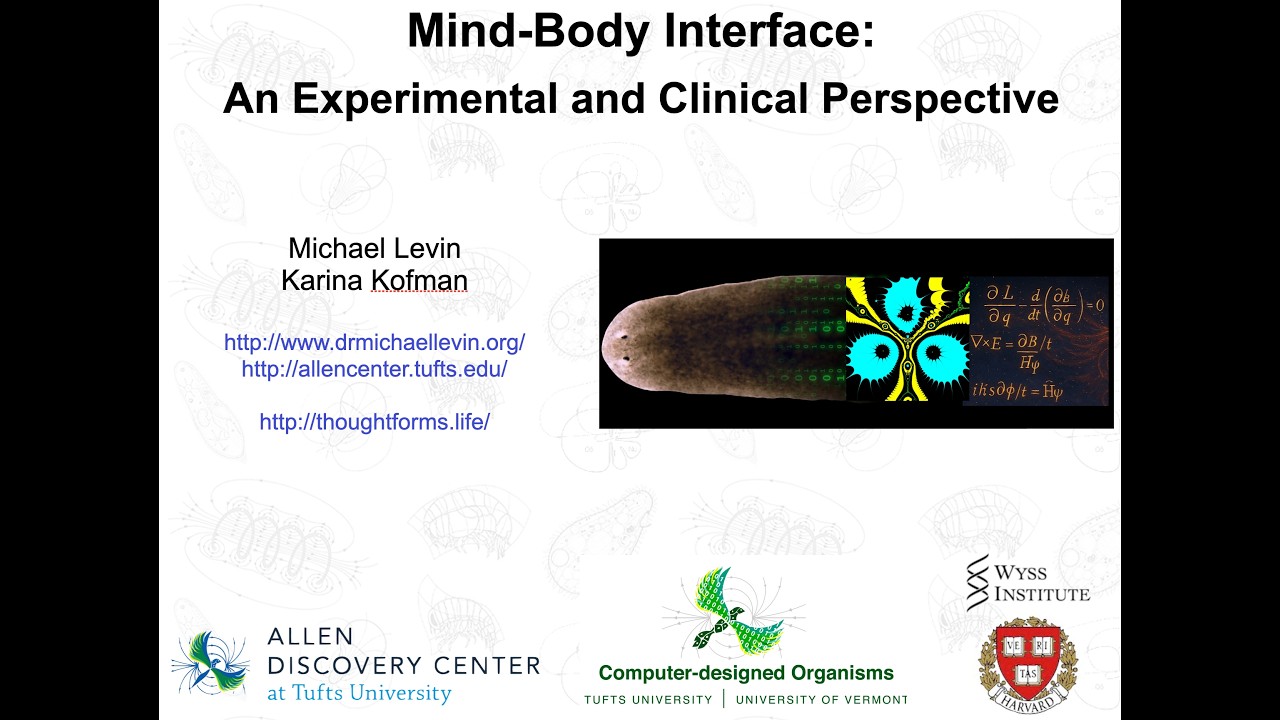
"Mind-Body Interface: an experimental and Clinical Perspective" by Michael Levin and Karina Kofman
This talk by Michael Levin and Karina Kofman argues that minds and bodies exchange information in ways standard biology does not fully explain, built on the claim that cognition runs on a continuum from single cells and bioelectric networks up through regenerating organisms to the human brain, with no sharp line separating physics from mind. It draws on the presenters' own described lab work (bioelectric signaling, anthrobots, regenerating planaria and frogs) and a published literature review of clinical cases (hydrocephalus, absent brain hemisphere, transplant personality change, anesthesia awareness, near-death memory, terminal lucidity) to argue cognition sometimes persists or transfers in ways not tied to normal brain architecture. In the back half the talk moves from that evidence base into explicit speculation, proposing a nonphysical 'platonic' or 'latent space' of patterns, not limited to mathematics, that minds participate in, a dualist position the speaker himself calls controversial and says is beyond his pay grade to resolve. Evidence ranges from the speakers' own experiments and a named literature review (RESEARCHER-STATED and PUBLISHED) to analogy (Huxley's reducing valve) and openly flagged philosophical speculation, and the source marks several explicit points where it crosses from clinical evidence into metaphysical interpretation.
Claim (RESEARCHER-STATED) [02:22]: Levin argues developmental biology shows no bright line separating physics from cognition, so continuous models of transformation are needed instead of a fixed threshold.
- Claim (SPECULATION) [49:24]: the speaker states a position that beings are not physical things occasionally touched by nonphysical patterns, but are the patterns themselves, experiencing embodiment through interfaces like a two-headed flatworm, an anthrobot, a human, or a cyborg.
- Claim (SPECULATION) [44:40]: the speaker proposes that a nonphysical 'latent space' of patterns affecting the physical world is not limited to mathematics.
- Mechanism (RESEARCHER-STATED) [03:12]: what unifies an embryo of roughly 500,000 cells into one individual is commitment among cells to a shared anatomical path, not a cell count fixed by genetics.
- Mechanism (RESEARCHER-STATED) [03:43]: scratching a blastoderm into islands causes each island to form its own embryo, which the speaker says is how human twins and triplets arise naturally or artificially.
+ 51 more takeaways
- Mechanism (RESEARCHER-STATED) [05:39]: molecular networks inside a single cell can perform Pavlovian conditioning, association, and habituation, and the speaker says others have found these models capable of Bayesian inference.
- Mechanism (RESEARCHER-STATED) [06:46]: ion channels and electrical synapses in bioelectric networks are described as containing the goals, memories, and preferences of the animal, illustrated with a zebrafish brain.
- Mechanism (RESEARCHER-STATED) [07:19]: about 25 years ago the speaker's group developed the first techniques to read and write the bioelectric 'thoughts' of the body, shown in a frog embryo.
- Mechanism (RESEARCHER-STATED) [09:06]: grafting a tail onto the side of an amphibian where a limb should be causes tail tip cells to remodel into a limb, with tail tip cells becoming fingers.
- Mechanism (RESEARCHER-STATED) [15:40]: in planaria, the regenerated worm revisiting original trained feeding locations (place conditioning) after head regrowth suggests the original memory was stored outside the brain and later imprinted onto the new brain.
- Mechanism (RESEARCHER-STATED) [16:27]: changing a bioelectrical pattern 'memory' altered how many heads tissue builds, producing two-headed animals instead of the normal one-head-one-tail pattern.
- Mechanism (SPECULATION) [46:46]: nonphysical mathematical truths are proposed as the explanation for why certain things do and do not happen in the physical world, through both constraints and enablements.
- Cited evidence (PUBLISHED): the talk is based on 'Cases of Unconventional Information Flow Across the Mind-Body Interface' by Karina Kofman (University of Toronto) and Michael Levin (Tufts Allen Discovery Center, Harvard Wyss Institute), published in Mind and Matter 23(1), 13-69.
- Cited evidence (RESEARCHER-STATED) [12:29]: Anthrobots, made from adult human tracheal cells with no genome editing, self-assemble into motile creatures, described as the speaker's own lab's work.
- Cited evidence (RESEARCHER-STATED) [12:57]: Anthrobots show over 9,000 new gene expressions different from their body cells and exhibit four distinct behaviors.
- Cited evidence (RESEARCHER-STATED) [13:07]: placed on injured human neurons, anthrobots cluster into a 'superbot' formation and heal the scratch-wound gap within four days.
- Cited evidence (PUBLISHED) [14:57]: planaria memory-transfer research is attributed to Tal Shomrat, Moran Neuhof, Michael Levin, and Oded Rechavi.
- Cited evidence (PUBLISHED) [15:13]: McConnell is credited with discovering the planaria memory phenomenon in the 1960s, later confirmed by modern tools.
- Cited evidence (PUBLISHED) [19:51]: in Xenopus laevis tadpoles, researchers prevented primary eyes from forming and grew an eye on the tail instead.
- Cited evidence (PUBLISHED) [20:19]: a device built to train these tadpoles on visual cues found the animals could see out of the brain-disconnected eye.
- Cited evidence (PUBLISHED) [24:03]: Dr. Lorber, in the 1980s, studied hydrocephalus children and found ventricular enlargement did not always correspond to cognitive impairment.
- Cited evidence (PUBLISHED) [24:33]: one Lorber case, a university math student with hugely enlarged ventricles and a thin remaining layer of brain tissue, had an IQ of about 126 and completed his math degree with first-class honors.
- Cited evidence (PUBLISHED) [25:01]: Figure A describes a 44-year-old man who lived a normal life as a married civil servant with two kids and no major neurological issues.
- Cited evidence (PUBLISHED) [25:12]: Figure B describes a 60-year-old man who came in for depression and overthinking and incidentally had a scan showing huge ventriculomegaly.
- Cited evidence (PUBLISHED) [25:23]: Figure C describes a 72-year-old Canadian woman working a retail job whose scan incidentally showed unnoticed hydrocephalus.
- Cited evidence (PUBLISHED) [25:52]: a 2020 case followed a girl born without her left brain hemisphere who developed age-appropriate and in some areas exceptional language abilities through her teenage years.
- Cited evidence (PUBLISHED) [28:46]: reported incidence of intraoperative awareness with recall ranges from 0.017% up to 4%, with higher rates in higher-risk groups.
- Cited evidence (PUBLISHED) [29:10]: in one study, 46% of cardiac arrest survivors reported forming memories while transitioning toward death (Parnia et al, 2014).
- Cited evidence (PUBLISHED) [29:45]: Dr. Sam Parnia in New York produced an original 2014 cardiac-arrest consciousness study with a 2023 follow-up reporting similar findings.
- Cited evidence (PUBLISHED) [31:04]: German researcher Michael Nahm described a young man with end-stage lung cancer whose tumor had replaced most brain tissue becoming responsive and saying goodbye hours before death, and a one-year-old woman sitting up and calling her husband's name shortly before dying after two severe strokes.
- Cited evidence (PUBLISHED) [32:28]: a 2012 study by Carhart-Harris using BOLD fMRI found psilocybin decreased cerebral blood flow and brain activity, with no regions showing increased activity, despite subjects reporting dramatically altered, vivid conscious experience.
- Cited evidence (PUBLISHED) [34:40]: citing Liester 2020, heart transplant recipients showed unexpected changes in food preferences, emotions, personality, music interest, art interest, and sexual preferences matching their donor's traits.
- Cited evidence (PUBLISHED) [35:00]: one heart recipient who previously liked McDonald's and meat developed a strong meat aversion after transplant, and the donor was later found to have had vegetarian tendencies.
- Cited evidence (PUBLISHED) [35:51]: these transplant cases were blind, recipients were not given donor information, and researchers found trait similarities only by separately interviewing the donor's family.
- Cited evidence (PUBLISHED, no author/year given in source) [36:38]: in the rubber hand illusion experiment, synchronous stroking of a hidden real hand and a visible rubber hand causes physiological reactions such as pain response and increased skin conductance and pulse when the rubber hand is threatened.
- Cited evidence (PUBLISHED) [38:51]: a woman in her 30s heard voices telling her she needed a brain scan, had no symptoms, but the scan revealed a brain tumor (Azuonye, 1997).
- Cited evidence (PUBLISHED) [39:00]: after the tumor was surgically removed, the voices said goodbye and disappeared.
- Cited evidence (PUBLISHED) [39:23]: mathematician Ramanujan described many of his mathematical insights as coming through experiences involving the Hindu goddess Namagiri (Rajendran, 2012).
- Cited evidence (RESEARCHER-STATED) [39:46]: Kim Peek, who inspired the Rain Man character, had major neurological abnormalities yet memorized thousands of books and showed strong erudition in many domains.
- Cited evidence (SPECULATION) [43:03]: a Halley plot of a simple complex-number function shows an organic structure the speaker says comes from neither selection, physics, nor training, offered as a suggestion of another information source.
- Cited evidence (PUBLISHED) [50:29]: a cited case describes a woman whose internal voices told her to get an MRI; after a tumor was excised, the last message received said 'We are pleased to have helped you.'
- Analogy [33:43]: the speaker references Aldous Huxley's idea of the brain as a 'reducing valve,' suggesting the brain may constrain or filter information otherwise available to the mind.
- Term defined [28:02]: BIS (Bispectral Index) is an EEG-based algorithm used to rate patient consciousness during anesthesia, with a score of 100 meaning fully awake.
- Term defined [28:42]: intraoperative awareness with recall is the term for patients regaining awareness during surgery despite anesthesia.
- Term defined [30:33]: terminal lucidity is an unexpected return of mental clarity or communication shortly before death in patients with severe neurological disease or brain damage.
- Term defined [40:09]: a savant shows extraordinary ability disproportionate to their other cognitive abilities, and savant syndrome can appear after brain injury or spontaneously without obvious prior training.
- Term defined [01:04:21]: patterns are defined as observable wayfinding policies for navigating spaces, used by agentic beings at all levels of the hierarchy.
- Term clarified [01:03:40]: the speaker avoids the word 'form' for its Platonic static connotation, using 'pattern' instead since many patterns can change, though some may be static.
- Open question [04:24]: how many cognitive agents can exist per cubic millimeter of brain tissue, citing split-brain patients and dissociative identity disorder as evidence the one-to-one brain-to-personality assumption is not strictly true.
- Open question [10:21]: where the cognitive features and goals of novel beings come from, since the speaker says evolution can't explain them.
- Open question [20:33]: why no rounds of evolutionary adaptation were needed for normal behavioral competencies to work with a radically altered sensory-motor architecture in the tail-eye tadpoles.
- Transition point, science to speculation (SPECULATION) [42:06]-[44:40]: after describing the Halley plot example, the speaker moves from the standard three sources of competency (design, evolution, training) to proposing a nonphysical latent space of patterns underlying cognition.
- Transition point, explicit audience challenge [53:00]: an audience question asks whether science can investigate the source of these 'ingressing patterns' or whether the method 'runs out' and requires religion or spiritual exploration; the speaker responds he will stick to science.
- Limitation, stated by speaker [53:00]-[55:00 range not given]: the speaker says he makes no claim that his models are a final answer, only a scientific advance, and that the origin of mathematical/Platonic facts is 'beyond my pay grade.'
- Limitation (RESEARCHER-STATED) [01:01:53]: the speaker says that of all his unconventional views over the decades, this dualist perspective has drawn the most hate mail.
- Limitation (SPECULATION) [01:02:12]: the speaker argues monism cannot simply be assumed and must be worked for, treating the physical and non-physical/mathematical as two distinct but interacting realms more tractable to study separately for now.
![Cited evidence (PUBLISHED) [29:10]: in one study, 46% of cardiac arrest survivors reported forming memories while transi](assets/KLWm0Qyj3jg/frame_1751.jpg)
![Cited evidence (PUBLISHED) [32:28]: a 2012 study by Carhart-Harris using BOLD fMRI found psilocybin decreased cerebral b](assets/KLWm0Qyj3jg/frame_1933.jpg)
![Cited evidence (PUBLISHED) [34:40]: citing Liester 2020, heart transplant recipients showed unexpected changes in food p](assets/KLWm0Qyj3jg/frame_2058.jpg)
How this brief was shaped: Neuroscience / Mind Science · confidence Medium
Transcript frames mind-body interface claims with experimental cases like planaria memory transfer, and OCR shows a dense string of named, dated research citations on brain malformations and cognition plus anesthesia awareness studies, matching the claim-mechanism-evidence grading pattern of the neuroscience lens more than a general lecture.
The lens sets this brief's structure, never its facts — every claim is held to the same citation and fact-check standard.