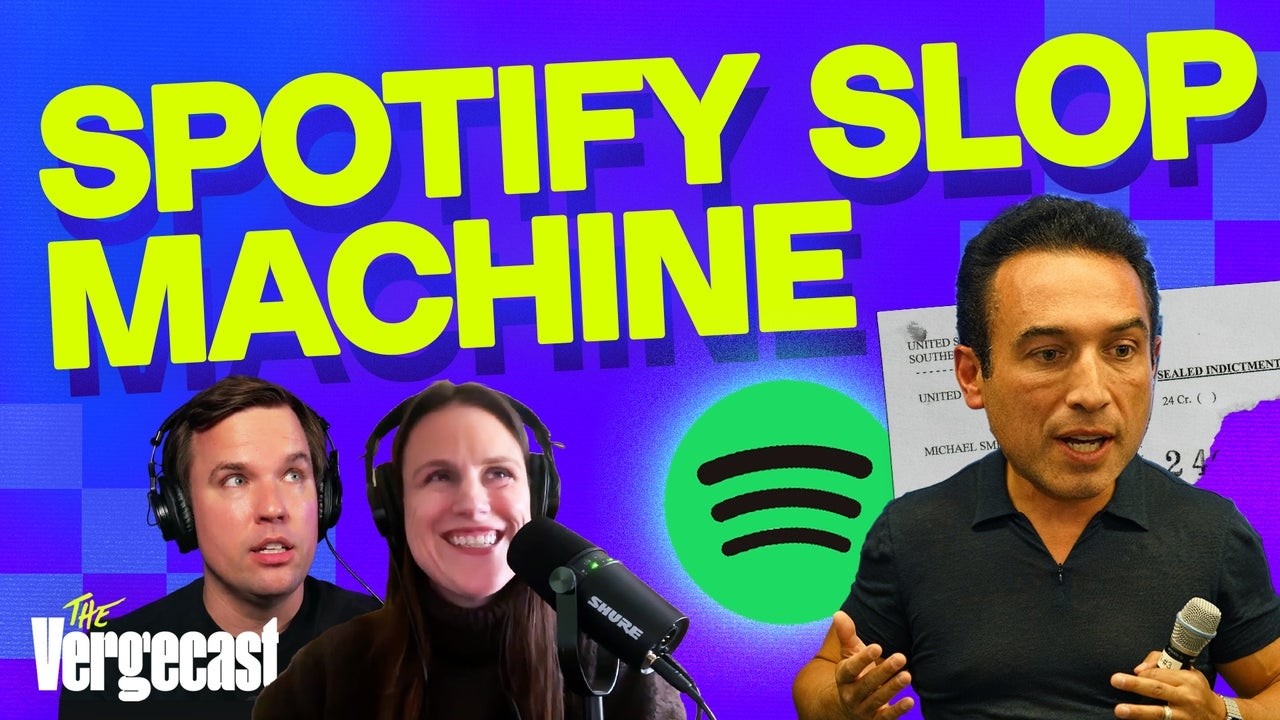
The $8 million AI music scam | The Vergecast
This Verge Hotline-style episode features a host and guest, Wired reporter Kate Nibbs, discussing her reporting on Mike Smith, the first person to face criminal charges for AI streaming fraud. The discussion centers on how Smith allegedly used an AI song generator, fake artists, and bot networks to siphon streaming royalties, and on the broader question of where the line falls between AI-assisted content, so-called AI slop, and actual legal fraud. Kate Nibbs highlights the tension that putting AI-generated songs on streaming platforms was not itself illegal since the real charge was artificial stream inflation, and she expresses doubt that one prosecution will deter future AI-fraud schemes run from overseas. The host's identity is not stated in the extracted points.
The core subject is Mike Smith, who was arrested and faced the first criminal charges brought against someone for AI streaming fraud [00:14]
- Kate Nibbs said that before the fraud scheme, Smith ran a series of urgent care clinics in North Carolina [03:55]
- Kate Nibbs said Smith used the clinic profits to fund his music ambitions [04:06]
- Kate Nibbs said Smith self-produced music videos, many of which are still on YouTube [04:14]
- Kate Nibbs said Smith would pay established artists to produce remixes or use their music as a way to build a foothold in the industry [04:24]
+ 39 more takeaways
- Kate Nibbs said this pay-for-remix practice is a fairly commonplace but little-known pocket of the music industry [04:28]
- Kate Nibbs said Smith met Jonathan Hay and the two started a record label together, continuing the pay-to-play model [05:20]
- Kate Nibbs said Smith financed a reality show on BET about finding the next great rapper, on which he served as a judge [05:23]
- Jonathan Hay, as relayed by Kate Nibbs, said Smith had been experimenting with artificial streaming for years before using AI, which caused a falling out between them [06:53]
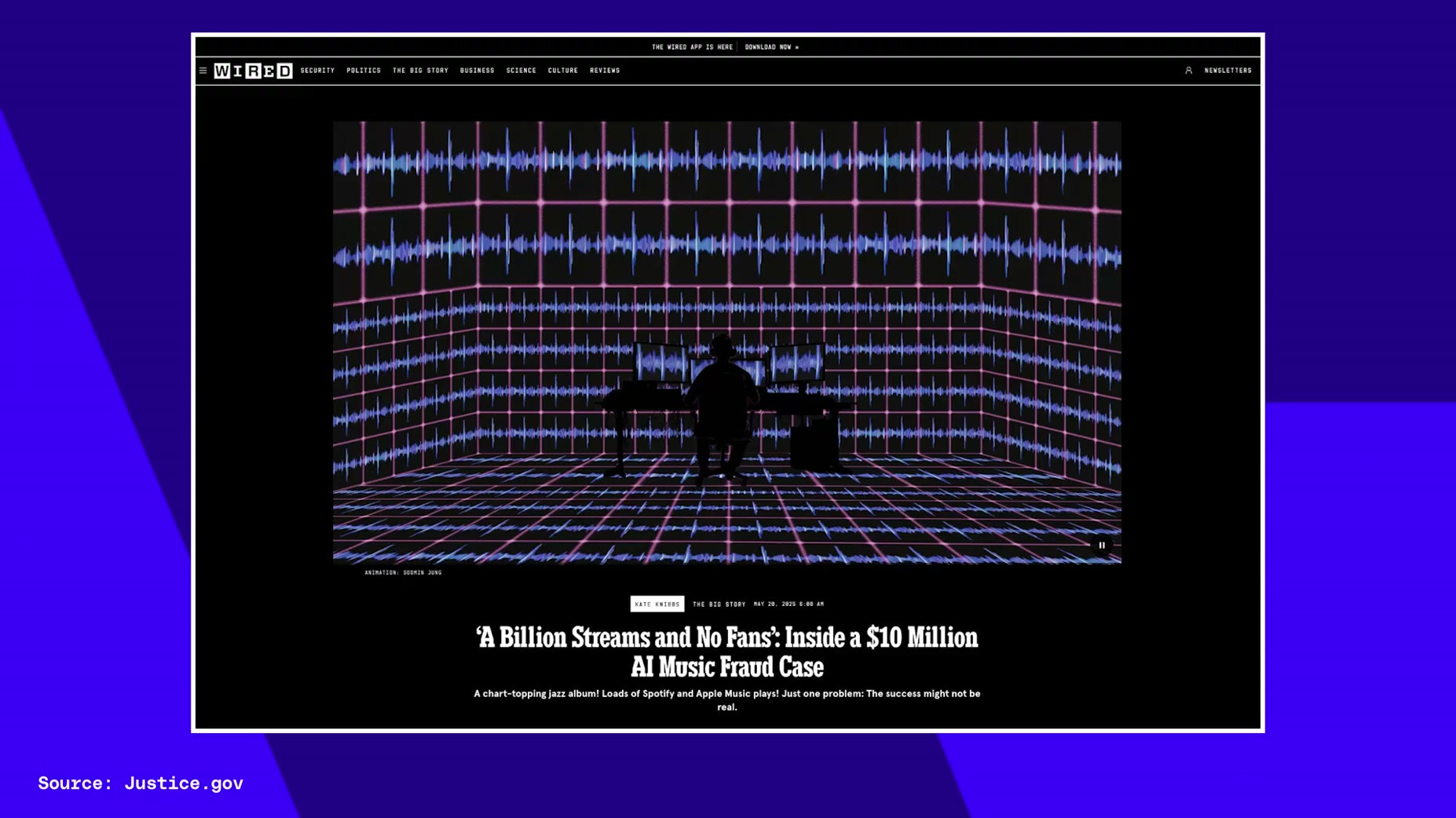
- Kate Nibbs reported that according to the US government's case, Smith made millions of dollars by creating hundreds of thousands of AI songs and using bots to loop them on repeat [09:49]
- The government ordered Smith to repay $8,091,843.64 [10:01]
- Kate Nibbs said Smith used an AI song generation service called Boomi, described as a pre-Suno tool similar to Suno or Udio, to quickly generate songs from prompts [10:15]
- Kate Nibbs said Smith created fictitious musical artists and distributed the AI-generated music through streaming distribution services, including DistroKid [10:15]
- Kate Nibbs noted that DistroKid is currently in a lawsuit with Universal Music Group, with UMG arguing DistroKid is like a slop purveyor [11:04]
- Kate Nibbs said Smith created networks of bots to stream his songs on loops [11:24]
- Kate Nibbs said Smith funneled the streaming money back to himself [11:40]
- Kate Nibbs said Smith made about $8 million from the scheme, which she called small for AI valuations but huge for music streaming because streaming pays very little [11:42]
- Kate Nibbs said bodies like the RIAA help keep the music industry in check even though they do not formally regulate it [12:27]
- Kate Nibbs said Spotify caught Smith right away and he only collected tens of thousands of dollars from Spotify before being caught [12:49]
- Kate Nibbs said Spotify had just removed 75 million AI-generated songs, but noted there is nothing disallowing AI broadly on the platform and never has been [16:23]
- Kate Nibbs said putting AI songs on streaming platforms was not itself a crime, calling it maybe a crime against taste rather than against the law [17:46]
- Kate Nibbs said streaming platforms do prohibit artificial stream inflation, which is what Smith was actually charged for [17:56]
- Kate Nibbs said Smith was charged with fraud for a combination of duplicitous actions, not one single act [18:48]
- Kate Nibbs said Smith hired Diddy's legal team and she thought the case had a decent chance of going to trial, but he pled guilty [19:23]
- Smith was sentenced to 18 months in prison [20:08]
- Kate Nibbs said she interviewed Morgan Hayduck, an executive at an anti-fraud company that detects AI music and fraudulent streams, for the story [23:00]
- Kate Nibbs said Hayduck told her Smith's mistake was staying in the United States while savvier AI slop grifters operate from places like a beach in Cambodia [23:07]
- Kate Nibbs said the case for Smith being a scammer rests on the fact that he had many artists and songs he did not care about, but cared about the money they generated [23:52]
- Kate Nibbs said the piece was titled 'A Billion Streams and No Fans' because Jonathan Hay found it strange the songs hit the Billboard charts while being unknown [25:00]
- Kate Nibbs said a podcast company had once planned to make a billion AI podcasts, reasoning that even 15 listeners each would be profitable since marginal cost is nothing [26:12]
- Kate Nibbs said LinkedIn once pushed people to use AI to make posts and has since introduced a button users can click to flag AI slop on their scroll [28:23]
- Kate Nibbs said she doubts jailing one person will stop much, since an aspiring AI slop grifter could learn from the case and simply operate from Thailand or Mexico City while obscuring their identity [28:53]
- Kate Nibbs said there was a separate controversy about prediction markets being manipulated to juice Spotify streams [32:21]
- Kate Nibbs said people were artificially botting songs on Spotify so they could make winning trades on prediction markets, creating a new incentive to bot [32:45]
- Kate Nibbs said prediction market companies say they are taking efforts to ensure legitimacy and integrity, since losing bets to juiced streams would drive users away [33:33]
- Kate Nibbs said there have been positive steps toward better spam filters removing purely AI-generated slop, such as Shrimp Jesus or Mike Smith's songs, from platforms [34:18]
- Kate Nibbs said the world is moving toward most online content being at least AI-assisted rather than fully AI-generated slop, which raises the question of how to assess quality [34:50]
- Kate Nibbs said that despite her own personal revulsion at using AI to write news articles, she doubts most of the general public cares whether content is partly AI-generated or AI-assisted [35:21]
- Kate Nibbs said Spotify has no direct financial incentive to detect AI content since it does not cost the platform money [36:37]
- Kate Nibbs said Spotify's anti-AI efforts so far are driven by reputational concerns, not profit [36:52]
- Kate Nibbs said she doubts a clean binary of AI versus not AI will remain feasible as AI becomes embedded in most music production, predicting platforms will only filter out fully AI-generated tools like Suno, Udio, and Crumbs [37:12]
- com right now for an exclusive $50 off when you spend $500 or more with code VERGECAST.
- Apple's $299 smart display is up for pre-order now, and it's designed to be kind of your family's central control system.
- As long as I have been covering this space, it has just been common knowledge that if you have $10 and 10 minutes, you can go buy yourself a million Instagram followers or as many views on YouTube as you want.
![Smith was sentenced to 18 months in prison [20:08]](assets/OzCSF16I_fQ/frame_1210.jpg)
How this brief was shaped: Discourse (interview / podcast / video essay) · confidence Medium
Transcript opens with host David Pierce introducing guest Kate Nibbs for a structured Q&A about Mike Smith's AI streaming fraud case, with back and forth exchanges like his hypothesis about what Smith would have done with the money, which is classic interview format. OCR confirms this is a Vergecast podcast episode, and a separate unrelated news rundown segment opens the show before the interview proper.
The lens sets this brief's structure, never its facts — every claim is held to the same citation and fact-check standard.