Chinese SETI Just Detected an Intriguing Signal (Not Aliens)
This video is hosted by a narrator called Anton on what the transcript indicates is a science/space-focused YouTube channel covering updates in the search for extraterrestrial intelligence (SETI). The video is organized around a named 2026 study, 'A Wavelet-integrated Search Pipeline for Narrowband Technosignatures in FAST Observations of 33 Exoplanet Systems' (Zi-Qi Li, Jian-Kang Li, and co-authors), which uses a Multiscale Wavelet Net and multi-stage filtering pipeline to screen FAST telescope data for candidate alien signals. The video also covers two related findings, a radio-emission detection at the exoplanet Beta Pictoris b and a Planet-Planet Occultation radio search at TRAPPIST-1, as further SETI efforts. Anton frames all of it around scientific caution, stating the channel sticks to rigorous, verifiable science rather than press speculation, and that none of the signals discussed have been confirmed as alien.
Concept [00:46]: Anton defines technosignatures as telltale signs of technology from intelligent civilizations outside the solar system, and says scientists apply heavy double- and triple-checking to every case.
- Framing [00:17]: Anton states there is no definitive answer yet on whether we are alone, and that while mysterious signals occasionally hint at something, this channel focuses on rigorous, verifiable science rather than press speculation.
- Named study [01:27]: 'A Wavelet-integrated Search Pipeline for Narrowband Technosignatures in FAST Observations of 33 Exoplanet Systems' by Zi-Qi Li and co-authors, received 2026 May 22, accepted 2026 July 21, published 2026 August 27, building on prior FAST targeted and blind SETI campaigns toward 33 exoplanet systems.
- Named study [01:35]: full author list given as Qi Li, Jian-Kang Li, Zhe-Wei Luo, Bo-Lun Huang, Yu Guan, Yu-Tong Fan, Zhen-Zhao Tao, Xiao-Hang Luan, Kang Jiao, Tong-Jie Zhang, Hai-Yan Zhang, and Liang Gao, affiliated with Beijing Normal University, Zhengzhou University, the University of Glasgow, and National Astronomical Observatories, corresponding author [contact removed].
- Mechanism [01:27]: the pipeline's Multiscale Wavelet Net produces an interpretable multiresolution representation of the radio data.
+ 44 more takeaways
- Mechanism [01:27]: a lightweight parameter estimator then performs endpoint localization on that representation.
- Mechanism [01:27]: narrowband detection is reframed as wavelet-guided feature extraction followed by endpoint regression, morphology-aware filtering, raw-data signal-to-noise validation, and multibeam anticoincidence veto, rather than relying only on a hard-threshold drift search.
- Mechanism [01:27]: applied to real FAST data, the pipeline recovers known events from prior analyses and produces a compact set of veto-ready candidates for human inspection.
- Framing [01:34]: the study produces one new exciting candidate signal plus a separate signal that initially seemed exciting but turned out to be caused by a planetary phenomenon many astronomers are excited about for a different reason.
- Mechanism [02:11]: the signal work comes from FAST, the Five-hundred-meter Aperture Spherical Radio Telescope, described as the largest radio telescope in the world.
- Named study [02:18]: Anton states a team led by G.K. Lee from Beijing Normal University published a study analyzing data collected over several years.
- Mechanism [02:28]: researchers used FAST's 19-beam receiver to conduct deep scans of several promising exoplanets.
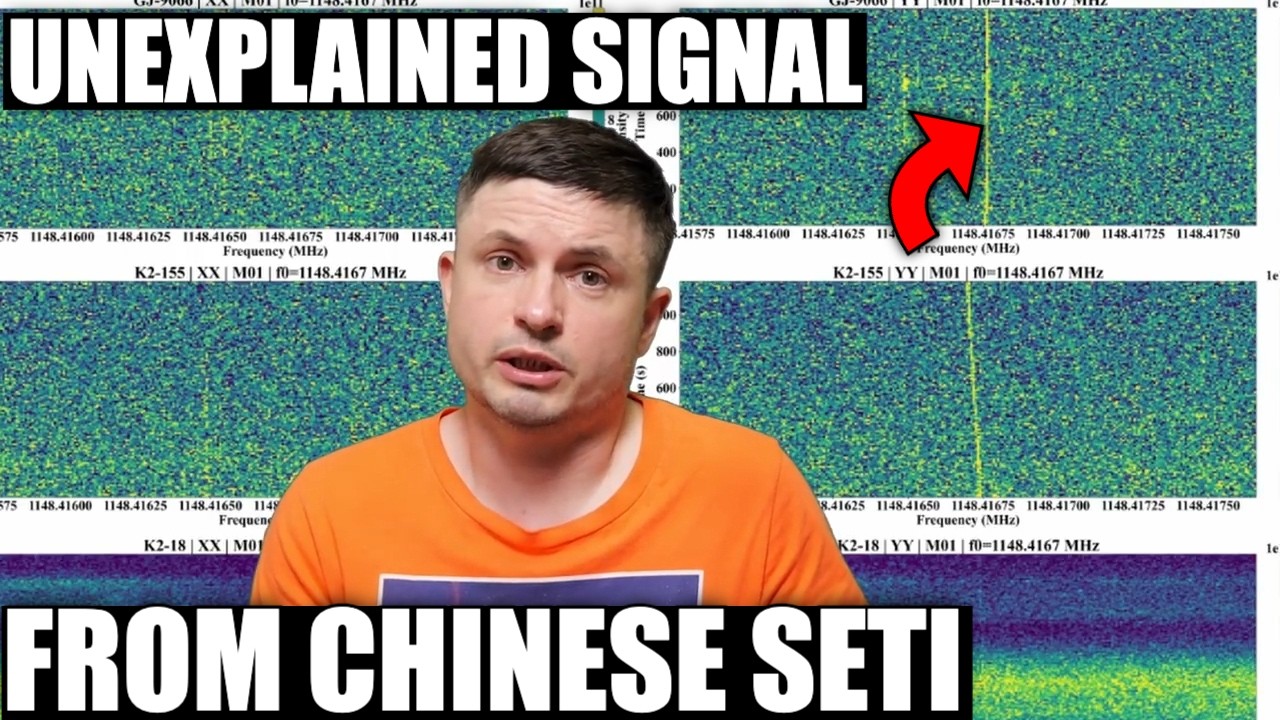
- On-screen artifact [02:40]: spectral plots shown reference target stars K2-155, K2-18, and Ross-128 at a frequency around 1148.4167 MHz.
- Concept [02:53]: natural cosmic objects (stars, gas clouds, pulsars, black holes, exoplanetary objects) emit across a broad range of frequencies, called broadband emission.
- Comparative example [03:11]: engineered transmitters compress energy into a very narrow frequency band because it transmits information more efficiently, unlike natural broadband emission.
- Concept [03:28]: almost no natural process produces a narrow radio signal, which is why finding one is described as extremely rare.
- Mechanism [03:36]: because planets orbit their stars, a transmitter on a distant planet should move relative to Earth, producing a frequency shift called the Doppler effect.
- Mechanism [03:52]: SETI researchers first look for signals that are both extremely narrow and drifting in frequency (Doppler drift) as the signature of a technosignature.
- Figure [04:02]: out of nearly 140,000 initial detections across 33 star systems, the machine learning pipeline narrowed the results to just two noteworthy events.
- Figure [04:26]: one of those two signals was ruled out as human interference.
- Named finding [04:36]: the remaining new signal appears to come from K2-155, a red dwarf about 238 light years away with three confirmed super-Earths, the outermost of which (K2-155 d) orbits near the star's habitable zone.
- Named signal [05:05]: the signal, designated NBS 260108, was discovered in January 2026 with a frequency close to 1148 MHz and a steady downward Doppler drift of about minus 0.038 Hz per second.
- Mechanism [05:40]: the signal appeared only in the central telescope beam pointed directly at K2-155, not in any other simultaneously observing beams.
- Mechanism [06:01]: a signal appearing in all beams almost certainly means it came from Earth, likely a satellite.
- Mechanism [06:32]: the signal appeared strongly in only one polarization channel, and similar signals at nearby frequencies appeared in observations of other nearby stars on the same day.
- Finding [06:44]: researchers concluded the signal is far more likely an unrecognized form of terrestrial radio frequency or instrumental noise, not an alien transmission.
- Why it matters [07:10]: the event shows machine learning algorithms can sift through millions of noisy signals and isolate a handful of candidates for human inspection.
- Mechanism [07:36]: the 1148 MHz frequency falls in the L-band, typically used by aerospace navigation and satellite networks.
- Mechanism [07:52]: aircraft and ground-based beacons use pinning signals near 1148 MHz to calculate an aircraft's precise distance from a runway or waypoint, satellites can produce spurious harmonics in that range, GPS satellites can create sideband emissions reaching down to 1148 MHz, and bounced signals off satellites, planes, or the atmosphere can mimic a Doppler drift, which Anton says is likely what happened with this signal.
- Named study [07:52]: a team led by Kevin Ortiz Ceballos at the Harvard and Smithsonian Center for Astrophysics used the MeerKAT radio telescope in South Africa to observe the giant exoplanet Beta Pictoris b, about 10 times more massive than Jupiter, producing the first time-lapse of it orbiting its star.
- Finding [07:52]: the team detected rapid repeating bursts of radio signals from Beta Pictoris b, the first unambiguous detection of radio signals from a distant exoplanet, though the source states the signals were natural and not narrowband.
- Mechanism [07:52]: the speaker states planetary radio emissions usually come from direct magnetic interaction with a close-orbiting star or from auroras, and auroras producing electron cyclotron maser emission appear to be the cause here.
- Figure [11:01]: Beta Pictoris b's magnetic field is measured at approximately 1250 Gauss, about 2500 times higher than Earth's and 300 times higher than Jupiter's.
- Why it matters [11:14]: scientists now have a chance to study the magnetosphere of this very different type of object and its effects on the planet and other objects in its system.
- Why it matters [11:24]: Anton states Earth's magnetosphere is one of the main reasons Earth is still habitable, protecting rocky planets from losing their atmosphere.
- Comparative example [11:42]: the video turns to TRAPPIST-1, a star system with seven terrestrial planets.
- Concept [11:57]: historically it was assumed an advanced civilization would build an ultra-powerful intentional beacon aimed at space to get attention.
- Concept [12:13]: modern astronomers instead focus on leakage radiation, everyday radio noise from a civilization such as radars, satellites, and interplanetary relays.
- Named study [12:27]: a recent study conducted a 20-hour-long search on TRAPPIST-1 focused on a Planet-Planet Occultation (PPO).
- Concept [12:37]: a Planet-Planet Occultation is when one planet in a system moves directly in front of another from Earth's view, and if aligned, radio emissions from communication between them, for example TRAPPIST-1b and TRAPPIST-1c, might be detectable.
- Mechanism [12:59]: the team checked whether communication between TRAPPIST-1b and TRAPPIST-1c could theoretically be detected via radio emissions.
- Why it matters [13:08]: the goal is described as potentially eavesdropping on alien communication if it exists.
- Figure [13:13]: the team filtered millions of signals detected during a 28-hour observation window.
- Figure [13:18]: the search found just over 2,200 candidate signals during that window.
- Finding [13:24]: all 2,200-plus candidates turned out to be human radio interference, so nothing conclusive was found.
- Why it matters [13:30]: despite no detection, the effort served as proof the technique can be used to intercept unintended signals.
- Concept [13:53]: confirming a true technosignature requires rigorous verification including a narrowband signal check, a Doppler shift, and appearance only when the telescope points at the star.
- Why it matters [14:20]: eliminating terrestrial radio interference from Starlink satellites, aircraft, and Wi-Fi is described as the single hardest challenge in modern SETI research.
- Why it matters [15:17]: Anton says the combination of better algorithms, better telescopes, and better techniques is slowly building the tools needed to properly listen to it all.
![Named study [01:27]: 'A Wavelet-integrated Search Pipeline for Narrowband Technosignatures in FAST Observations of 33 Ex](assets/PhAIRhkNDfw/frame_87.jpg)
![On-screen artifact [02:40]: spectral plots shown reference target stars K2-155, K2-18, and Ross-128 at a frequency aroun](assets/PhAIRhkNDfw/frame_146.jpg)
![Mechanism [07:52]: aircraft and ground-based beacons use pinning signals near 1148 MHz to calculate an aircraft's precis](assets/PhAIRhkNDfw/frame_393.jpg)
How this brief was shaped: Lecture / Educational Explainer · confidence Medium
A single narrator explains SETI technosignature detection methodology from a named peer-reviewed paper, walking through concepts like Doppler drift and a machine learning pipeline narrowing 140,000 detections to two events, with OCR showing the full paper title, authors, and abstract rather than any replicable code or steps.
The lens sets this brief's structure, never its facts — every claim is held to the same citation and fact-check standard.