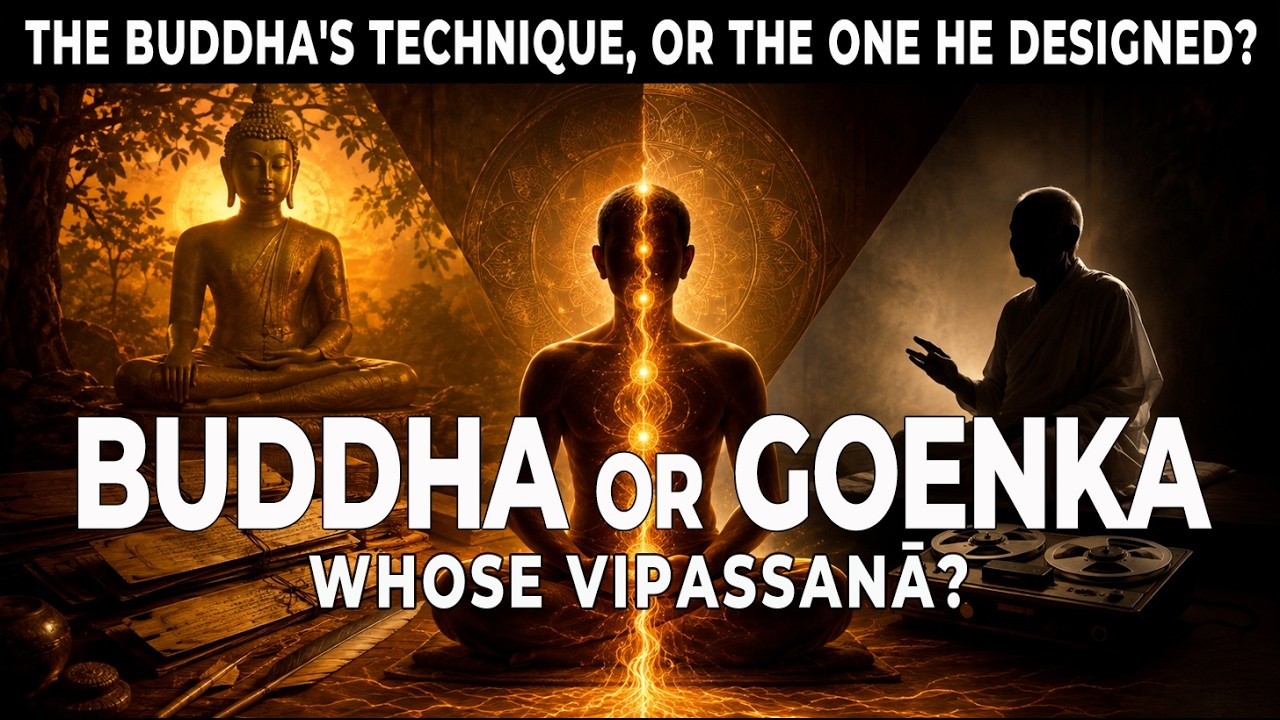
GOENKA: The Man Who Removed BUDDHISM from BUDDHISM?
This is a single-narrator video essay examining Vipassana meditation as taught through the recorded instructions of S.N. Goenka, who died in 2013 and whose tape-based teaching is now used in retreats across more than 90 countries. The narrator's central question is whether Goenka taught the Buddha's original technique or a method of his own construction, built around two competing readings of the Pali word 'kaya' in the third of 16 steps in the Anapanasati Sutta: a literal 'physical body' reading versus a 'body of the breath' reading. The piece traces this tension through the 5th-century Sri Lankan monk Buddhaghosa and his Visuddhimagga, a contemporaneous Chinese translation by Kumarajiva, and the traceable lineage through colonial Burma (Ledi Sayadaw, Saya Thetgyi, U Ba Khin) to Goenka, alongside later reporting on mental health risks and safety criticism from the Financial Times, without the narrator declaring a final verdict on which reading is historically correct.
The video's central question, posed by its narrator, is whether Goenka taught the Buddha's original Vipassana technique or a method of his own, centered on two competing readings of the Pali word 'kaya' in step three of the Anapanasati Sutta's 16 steps. [21:44]
- The narrator states that every year hundreds of thousands of people sit 10 days of silent Vipassana, almost all taught via a recording of S.N. Goenka, who died in 2013.
- The video states that in every hall across more than 90 countries, Goenka's recorded voice tells participants on day four that the instruction comes not from him but from the Buddha, unchanged for two and a half thousand years.
- The video states Goenka decided the recording should be used indefinitely so people would keep receiving the teaching exactly as he presented it, without addition or subtraction.
- Step three of the Anapanasati Sutta instructs practitioners to 'train yourself to experience the whole body, breathing in and breathing out,' using the Pali word kaya, which the video says ancient traditions read two different ways. [02:29]
+ 33 more takeaways
- Read literally as the physical body, kaya produces the Goenka-style body scan that moves attention through the face, shoulders, arms, torso, and legs sensation by sensation, per the video. [02:47]
- Read alternately as 'the body of the breath' (its whole shape from beginning to middle to end), kaya keeps step three focused on the breath with no body scan, per the video. [03:03]
- The narrator identifies Buddhaghosa as a monk who arrived in Sri Lanka from India in the 5th century as an outsider needing to earn access to commentaries held by the Mahavihara monks. [03:32]
- Buddhaghosa wrote the Visuddhimagga to prove his understanding of the Mahavihara tradition, and the video states the book became the foundation of Theravada Buddhism for the next 16 centuries. [03:43]
- The video states that, following the Mahavihara's reading, the Visuddhimagga defines the third step as 'the body of the breath' rather than a physical body scan, and notes other commentarial traditions did not survive, making this the institutionally-backed reading. [04:00]
- The video states that around 407 CE, shortly before Buddhaghosa reached Sri Lanka, the translator Kumarajiva rendered a Chinese text, the Dhyana Samadhi Sutra, describing the third step as awareness pervading the body inside to the toes and fingers and out through every pore, a physical-body reading. [04:38]
- The narrator cites Bhikkhu Analayo, a Theravada monastic scholar who compares early Buddhist texts, as finding that the Chinese account and Goenka's U Ba Khin lineage sit closely together and both stand apart from Buddhaghosa's reading.
- The video states Analayo writes the roots of the practice appear to reach back around 2000 years, but in later work adds that the systematic body scan as a distinct procedure was presumably unknown in earliest Buddhism and grew out of mindfulness of breathing.
- The video describes an advanced stage in Goenka's tradition called 'free flow,' where awareness passes through the entire body within a single breath, downward on the out-breath and upward on the in-breath.
- The video states the Chinese text's body-oriented reading has no documented route forward for over a thousand years, until a related method appears in the visible historical record in colonial Burma.
- The narrator credits Ledi Sayadaw, a scholar monk in colonial Burma, with taking meditation out of the monastery to teach farmers and clerks, after which systematic insight practice became something an ordinary layperson could expect to be taught.
- Saya Thetgyi is described as a layman teaching laypeople with no ordination behind him, followed by U Ba Khin, who brought the practice into his office as Accountant General of newly independent Burma, running courses for civil servants and foreigners. [08:32]
- The video states Goenka took the practice out of Burma after 14 years studying under U Ba Khin, moving to India in 1969 with 14 students in his first course. [08:43]
- The video states Goenka kept the classical sequence of Sila, Samadhi, and Panya (moral conduct, concentration, wisdom) and kept sensation as the field where insight happens, while setting aside monastic membership, ritual obligation, conversion, and any requirement to have studied the texts beforehand. [09:36][09:50]
- In August 2000, speaking to 2,000 religious leaders at the United Nations, Goenka claimed every religion has an outer shell of rites and doctrines and an inner core that is the same everywhere, and that what India calls Dharma is distinct from the major traditions, naming seven including Buddhism, per the video. [10:04]
- The video states that in March 1982 at the Burmese Vihara in Bodh Gaya, Bill Hart was given under a month's notice to lead the first 10-day course ever conducted by someone other than Goenka, and that when the tape for Day 1's evening sitting produced only a faint hiss, Hart gave the instructions himself for the rest of the course because his tapes lacked evening instructions entirely. [10:57][11:21]
- The video states that Thomas Chrisman, a former Texas lawyer whose direction changed after a course in Chicago, proposed recording a full 10-day course later that year, and that Goenka hesitated over equipment disturbing meditators until Chrisman promised to be like a little mouse. [12:28][12:38]
- From 1982 to 1986 Chrisman taped English courses in America each summer and Hindi-English courses in India each winter, facing faulty equipment, a power cut at Dhammagiri that had to be run off car batteries, and rain forcing Goenka to shout over a tent roof; only the sixth recorded course satisfied him, and 42 cassettes held one full course's audio, per the video. [12:56][13:06][13:27]
- The video states that in 1972 Vinoba Bhave, a spiritual successor of Gandhi, challenged Goenka to teach children and criminals, and that three years later Jaipur Central Jail held the first 10-day course inside a prison. [14:17][14:31]
- The video states that in April 1994 Goenka led a Vipassana course for 1,000 inmates at Tihar prison in Delhi and afterward opened Dhamma Tihar, described as the first Vipassana center established inside a prison anywhere in the world, following a November 1993 course for 96 inmates and 23 staff and a January 1994 course for 300. [14:44]
- The narrator states Goenka designed against the common pattern of founder-led movements fracturing after death by raising no single spiritual heir, training many assistant teachers, and fixing the core instruction in recordings; Goenka died in September 2013 at age 89, and the video says the course's architecture barely changed afterward.
- The video states that of the movement's 270 permanent centers, more than 200 are in Asia and India alone holds close to half the world's total.
- The video notes that in 2018 Twitter's chief executive sat a course wearing an Apple Watch and sleep tracking ring for all 10 days and told 4 million followers it was a way to hack the deepest layer of the mind.
- The video states that in January 2023, Financial Times investigations editor Madison Marriage received a tip from a worried father, leading to twelve months of reporting published in early 2024 that documented severe insomnia, paranoia, hallucinations, and breaks with reality, examined two deaths by suicide among former participants, and found these risks were not disclosed to applicants and that staff were not trained to respond when someone deteriorated.
- The video states network representatives responded to the Financial Times investigation by describing applicant screening, teacher guidance on mental health, procedures to remove someone from a course, and contacting relatives or medical professionals, and that the network's code of discipline now states old symptoms may resurface, conditions in remission may return, and Vipassana is not a substitute for psychiatric care.
- A 2020 review of 83 studies covering more than 6,000 participants found around 8% reported a negative effect from meditation, a rate the video says is similar to that found in studies of psychological therapies, with anxiety and depression most common, though the video cautions this review spans many practices at many intensities and cannot serve as a risk rate specific to a Goenka retreat. [19:32]
- The video cites the US National Center for Complementary and Integrative Health as noting too few studies have examined meditation for harm to say anything definite about its safety.
- The video states that the harder crisis-care gap opens after day 10, when a center can no longer guarantee contact with someone who has gone home, and argues informed consent should honestly describe intensity, name known adverse reactions, state that screening cannot predict every crisis, and establish that asking for help or leaving is not a spiritual failure. [20:44]
- The video states breath practice, bodily awareness, feeling tone, and the contemplation of impermanence are all canonical and none invented in the 20th century, while stating the ten-day course itself is unmistakably modern and unmistakably Goenka's own. [21:52][22:31]
- The video states the unbroken chain from the Buddha to Goenka's method is a matter of tradition rather than documented record, affirmed by the movement but not by documentation, with the visible historical trail beginning in colonial Burma. [22:19]
- The video notes a Chinese translation from the early 5th century preserves an image about water entering sand strikingly close to what Goenka taught, illustrating a documented but incomplete parallel. [22:08]
- The video closes by posing two unresolved framing questions without answering them: whether fixing a teaching protects it or eventually freezes a living tradition in place, and who has the standing to change it when something needs to change. [25:41][25:48]
- The video ends by inviting viewers who completed the course, walked out early, or only heard about it to read the comments, pointing to a prior Vipassana episode and a linked jhanas episode for further context, and closing with the line 'stay curious, stay wise.' [25:55][26:04][26:10][26:26]
How this brief was shaped: Discourse (interview / podcast / video essay) · confidence Medium
Single narrator opens by stating a claim (the vipassana instruction is unchanged from the Buddha) then explicitly interrogates it, tracing textual evidence through a Sri Lankan monk and a Chinese text and noting gaps in the record, which is an argued thesis being tested against evidence rather than a straight chronological retelling. OCR shows animated illustrative scenes (monks, tape recorders, historical figures) supporting narration rather than a lecture, course, or procedural context.
The lens sets this brief's structure, never its facts — every claim is held to the same citation and fact-check standard.