
Matt Pocock: The Most Valuable Skill to Learn in the Age of AI
This is a conversation between host Nate Herk and guest Matt Pocock, Founder at AI Hero, about how to get good work out of AI coding agents. The discussion centers on communication as the core skill for directing agents, Pocock's account of a months-long spec-driven development project on his video editor that got progressively worse rather than better, and ladder-style frameworks for handing agents more responsibility over time, including Pocock's trust ladder and Herk's own Herk Loop. A clear disagreement surfaces when Pocock pushes back on advice he attributes to Boris Cherny, Elon Musk, and Sam Altman to give agents your most ambitious tasks, arguing instead that menial, easily measured work is the better starting point.
Pocock states the core thesis of the conversation: the best way to get the best work out of AI agents is to tell them what you care about [00:07].
- Pocock claims the people most successful with agents are the best communicators, stated without evidence given [00:03].
- Pocock says the key skill for working with agents is being able to get everything out of your own head [00:13].
- Pocock says another key skill is being aware of unknown unknowns, such as security or deployment, because the agent will otherwise make stuff up [00:17].
- Pocock sees a career opportunity in taking agents and figuring out processes for knowledge work across organizations like law firms, agencies, clinics, SaaS, retail, and finance [00:33].
+ 55 more takeaways
- Pocock recounts a war story: he tried spec-driven development for months and watched the code and agent results get progressively worse [00:45].
- Pocock says he had about 10 years of coding as an amateur and then about 8 years professionally [02:01].
- Pocock marks the release of Opus 4.5 and the building of OpenClaw, around December 2025, as the threshold where he decided he would never write a line of code himself again [02:10].
- Pocock says the communication gap between a human and an agent exists regardless of how smart the model is, stated without evidence given [04:46].
- Pocock warns that if agents operate in a garbage, vibe coded codebase that no one cares about, the result is garbage in, garbage out [05:12].
- A speaker (attribution unclear in the extracted points) references Anthropic as having used novels for training and compensating authors afterward, cited as an example of dubious AI ethics [10:54].
- The guest says opportunities include producing applications that embed AI and consulting with companies on AI adoption [11:21].
- Pocock says people believe agents have no learning curve and you just talk to them and get stuff back, but he found that is absolutely not the case [12:43].
- Pocock says as models improve they don't necessarily lessen the learning curve, it just becomes more hidden [12:59].
- Pocock reasons that agents are good at code because code is easy to verify, the same way math problems are solvable because math is easy to verify [13:37].
- Pocock extends that reasoning to say real-world work is harder than coding for agents because it is much harder to verify [14:00].
- Pocock says even after fiddling with agents for a year and a half, he still finds it very difficult to adopt them for day-to-day work [14:43].
- Pocock cites a line from The Pragmatic Programmer, by Andy Hunt and Dave Thomas, that no one knows exactly what they want, as support for why unknown unknowns matter [16:26].
- Pocock describes one of his most-used skills, called Grill Me, which has the agent interview him relentlessly about what he's trying to build before writing code [16:55].
- Pocock says Grill Me works by extracting more context about what he cares about and surfacing unknown unknowns like security or deployment that the agent would otherwise make up or ignore [17:08].
- Nate Herk says the skill is being aware of unknown unknowns and not trusting that you've come up with a complete design [18:15].
- Nate Herk says turning an idea into code reveals the weaknesses in a design because it translates the fuzzy human brain into executable statements that must link together [18:35].
- The guest says when they first started building automations they tried to predict edge cases and build guardrails, but unexpected things still happened once in production [18:59].
- The guest says they told clients that despite built-in protections, unexpected real-world issues could still occur, so they would monitor the system to ensure failures happen safely [19:23].
- Nate Herk notes a trust gap exists because people can build impressive portfolios quickly, raising the question of how to prove expertise to a cold prospect among 20 competing vendors, stated without evidence given [19:43].
- Nate Herk offers a free AI OS template with guided setup and six skills, built around his framework called the Herk Loop: Context, Connections, Capabilities, and Cadence [20:35].
- The guest says they never were a traditional freelance consultant but had an existing audience and reputation going into client work [20:55].
- The guest says agents let you ship prototypes quickly, and at this point vibe coding is a good thing because it gets you to an endpoint fast [21:18].
- Matt advises that if clients are unsettled by how fast AI-assisted work gets produced, you should charge for five days of work but only spend four days actually working [21:53].
- Matt says people who are not 'AI-pilled' don't yet realize how quickly high quality work can be produced with agents, stated without evidence given [22:07].
- Matt observes that every top-tier developer he has seen has always been incredibly good at communicating, stated without evidence given [23:04].
- Matt says the best developers write detailed, clear reports about code changes because the clarity of their thinking ends up in the product they create [23:13].
- Matt introduces Domain Driven Design, centered on a 'ubiquitous language' where the terms used in code match those used by developers, clients, and users discussing the product [23:51].
- Matt mentions he built a modified version of his Grill Me tool called Grill with Docs, which helps build a shared domain glossary as you go [24:51].
- Matt mentions Anthropic announced something about consequences or prohibitions around being cruel or mean to Claude [25:35].
- Matt recalls being intrigued by a talk from Sean Grove, who works at OpenAI, called 'The New Code,' arguing that specs are the new code [26:44].
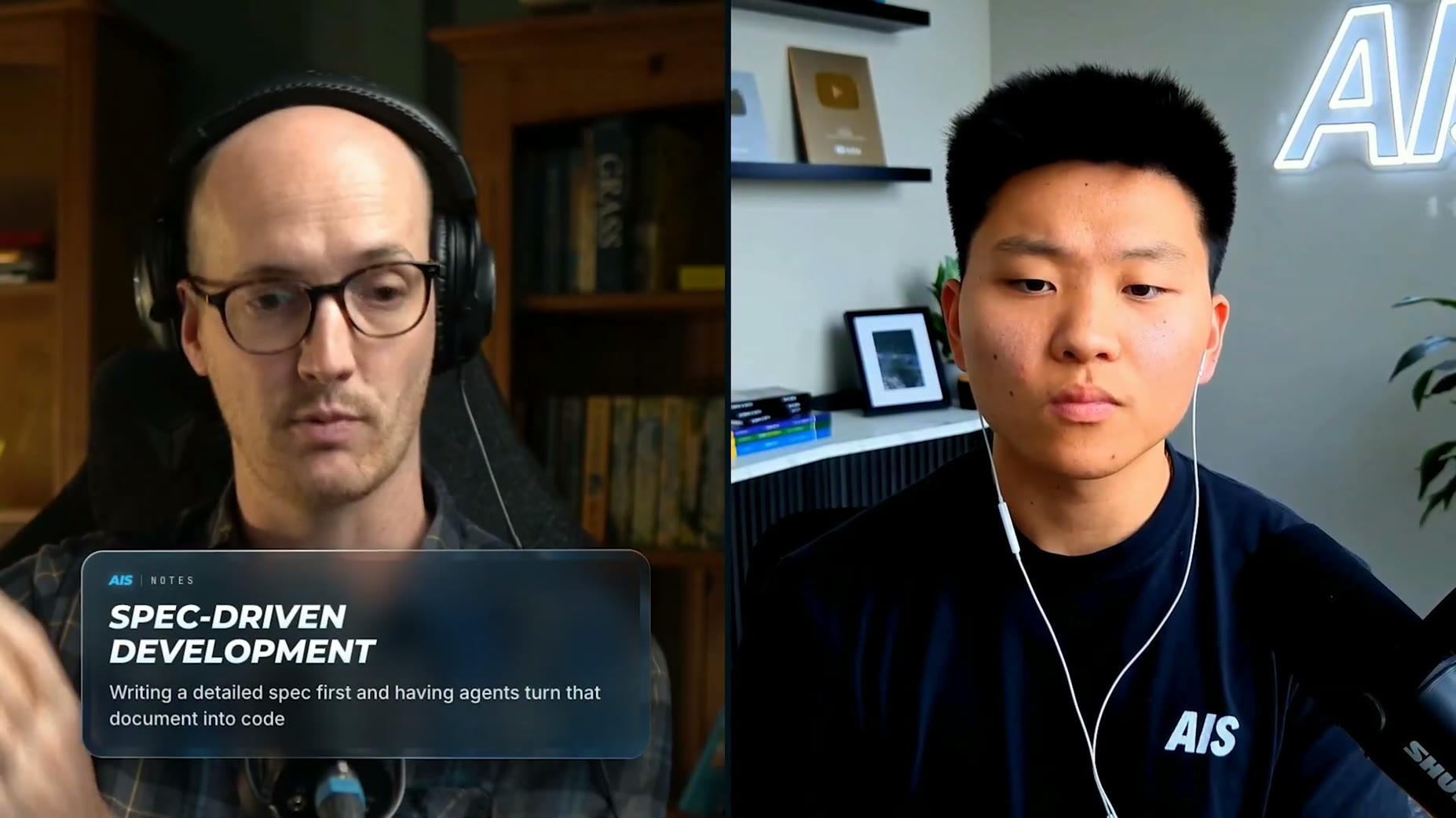
- Matt defines spec-driven development as writing a detailed spec first, having agents turn that document into code, then refining the specs as you go [27:20].
- Matt describes a repo he calls his pride and joy, a custom video editor similar to Descript with AI writing and thumbnail design features [27:37].
- Matt says he tried spec-driven development on this video editor project for months but found the code kept getting worse and the agent produced worse and worse results [27:53].
- Matt defines a good codebase as one that is easy to make changes in, where a change will not break something the agent did not think about [28:51].
- Matt defines a harness as the app that wraps a model with tools and memory, like Claude Code or Codex [30:04].
- Matt says he is now pushing around 200 to 300 commits a day, compared to about 20 a day before adopting these agent-driven methods [31:43].
- Matt says he currently uses Claude Code with Opus 5.5 at medium effort level, adding that most people run effort levels too high, stated without evidence given [32:04].
- Matt says effort level is a setting for how long a model thinks before it answers, and he is debating moving to low effort for better token efficiency and faster replies [32:26].
- Matt describes fixing a complicated video editor feature that relied on third-party dependencies like OBS running locally, so an agent could click through the browser, take screenshots, and run the app [33:11].
- Matt says he thinks of models as employees in his company and wants the base level of employee to be as good as possible [34:31].
- Matt claims even Opus 5.5 on low effort is better than the earlier Sonnet model that could already automate tons of knowledge work, stated without evidence given [35:04].
- Matt references an interview with Lauren Tan, who goes by Potato on Twitter and works at GrokBot, about climbing the trust ladder [36:28].
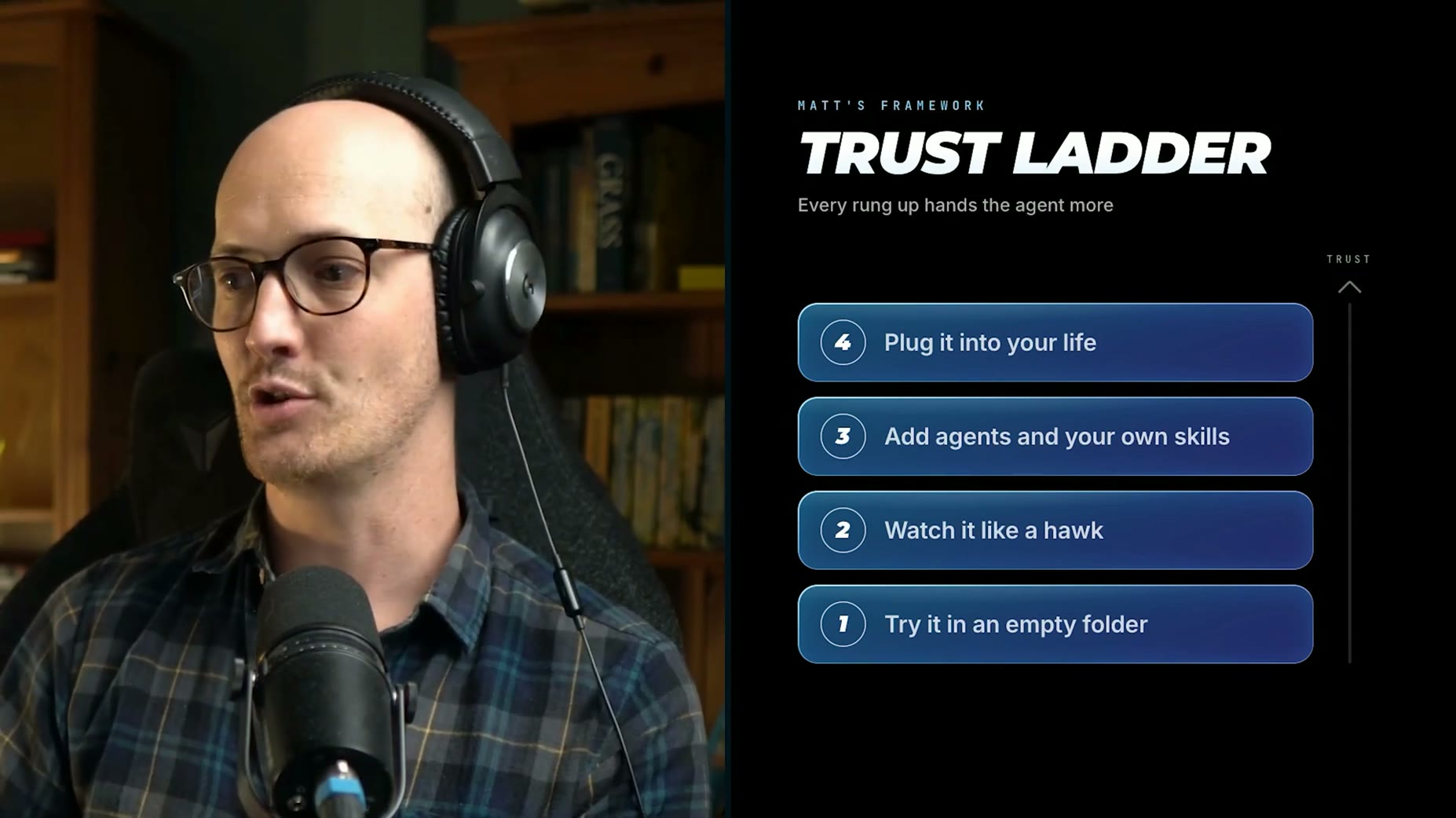
- Matt's trust ladder framework advises trying an agent in an empty folder first, then adding agents and skills while watching it closely, before eventually plugging it into your life, since each rung up hands the agent more trust [36:49].
- Matt describes an agent that handles his to-do list: he dictates to his watch, it pings a system, the item goes into his to-do list, and the agent triages it [38:25].
- Matt cites Boris Cherny, creator of Claude Code at Anthropic, along with Elon Musk and Sam Altman, as telling people to give the model their most ambitious tasks or goals [39:34].
- Matt explicitly disagrees with that advice, saying instead to give AI your most menial, boring work, like drafting replies, because you can measure the output easily [40:02].
- Matt says writing his own content has gotten much easier since he started plugging it into Sonic 5.5 to produce a first draft that he then iterates on [40:57].
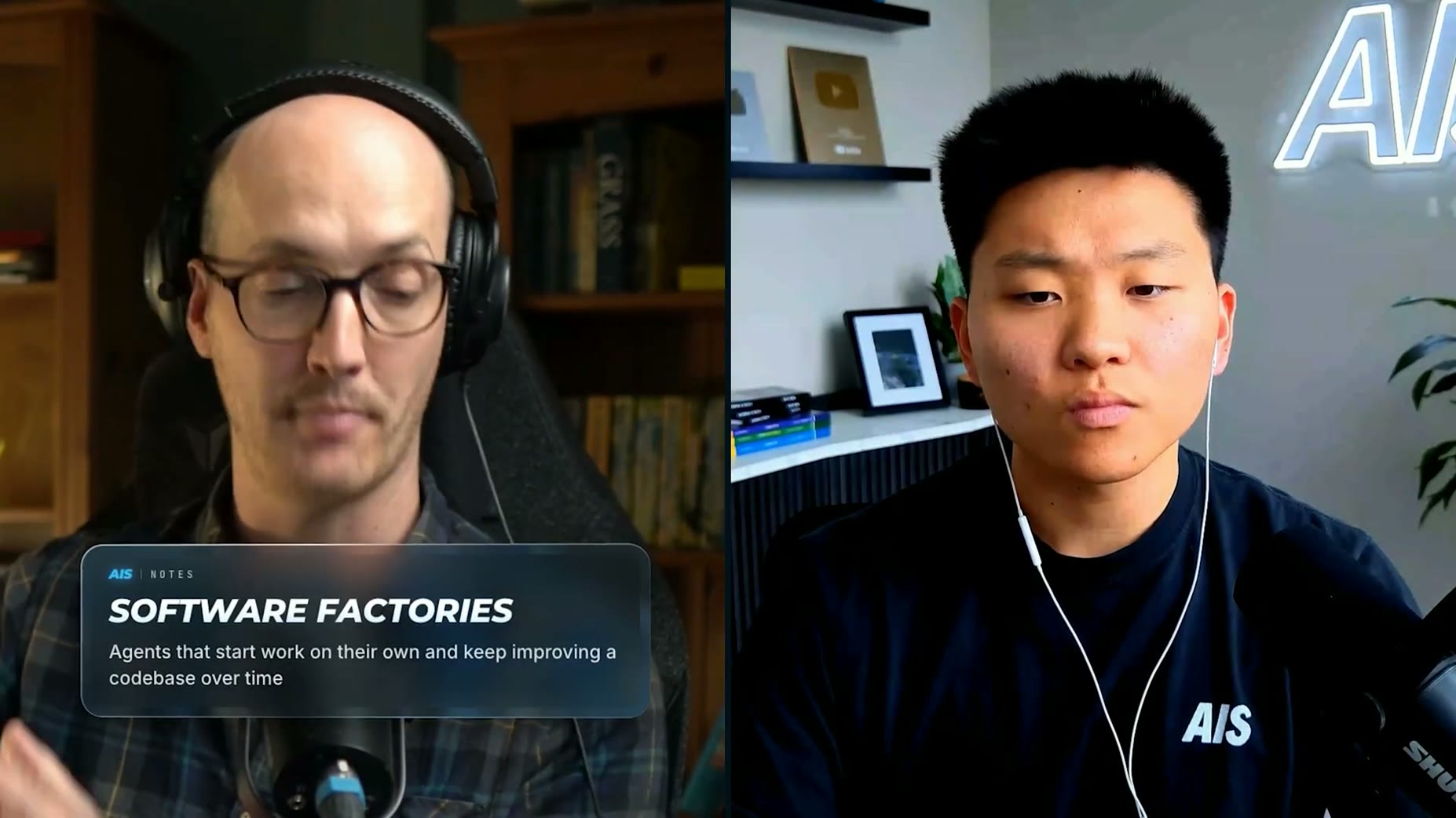
- Matt says he is excited about 'software factories,' defined as agents that start work on their own and keep improving a codebase over time, because current agents are not good at thinking long term about a codebase [42:46].
- Matt says agents are currently really bad at advocating for long-term code quality, though he thinks there is a way to make them good at it (timestamp not given in extracted points).
- Matt says the right way of organizing lots of agents hasn't been found yet, and nothing he has seen has convinced him of the right approach (timestamp not given in extracted points).
- Matt says he is excited that open models, meaning AI models whose weights are published so anyone can download and run them, will keep improving and eventually reach the level of Opus 5.5 (timestamp not given in extracted points).
- Matt can be found at AIhero.dev, where he has a newsletter, and also on Twitter and YouTube (timestamp not given in extracted points).
- On the explicit point of disagreement: Pocock rejects the ambitious-tasks advice credited to Boris Cherny, Elon Musk, and Sam Altman, favoring menial work instead; no counter-rebuttal from Nate Herk on this specific point is stated in the extracted points.
- No verbatim quoted dialogue appears in the extracted points provided, so quotable takes with exact wording are not stated.
How this brief was shaped: Discourse (interview / podcast / video essay) · confidence Low
Transcript shows two speakers in a sit-down interview exchanging views on agent communication, career strategy, a war story about degrading code quality, and a direct disagreement over AI ethics, which is a discourse spine even though it is structured as question and answer. OCR sample is almost entirely an unrelated VPS hosting sponsor read plus a generic Claude Code webpage screenshot, so it adds little to the routing and confidence is capped.
The lens sets this brief's structure, never its facts — every claim is held to the same citation and fact-check standard.