AI Can Copy Any App Now - Here's What People Will Still Pay For
The host, who co-founded the paid Claude Code Club, argues that an open source tool called REA is making it trivial for Claude and other AI agents to reverse engineer and rebuild almost any app for free, and that this means software's price is shifting away from how hard it was to build and toward results, support, and audience trust. The claim rests on the host's own account of REA's GitHub star growth, a handful of named developer case studies (Microsoft PowerToys, DX-Ball, QuickBooks/Ledger Reborn, ArtCraft/PhotoCraft), a quoted X post describing the tool, and the host's personal experience running his own paid community. Several key figures, including REA's star-growth timeline and the claim that copying costs keep dropping, are presented without an independent source.
Thesis (12:28): The creator's framing is that software is not dead, but the part of an app's price that came from being hard to build is going away.
- Argument 1 (00:08): REA lets you point Claude at an app you don't have the code for and Claude figures out how it works.
- Argument 2 (00:14): REA then lets you rebuild that app from scratch for free, the core premise driving the rest of the argument.
- Argument 3 (00:37): The creator frames REA's rise as happening the same week someone used Claude to build free, open source copies of seven Adobe apps (ArtCraft).
- Argument 4 (02:18): The argument rests on an analogy that every app on a computer is a sealed box, you get the app but never the underlying code.
+ 38 more takeaways
- Argument 5 (03:17): Shipped apps become unreadable machine code, and tools like Ghidra, Hopper, and IDA Pro can turn that back into readable code.
- Argument 6 (03:31): Ghidra is free and was built by the NSA; REA's contribution, per the creator, is letting Claude drive reverse-engineering programs like it.
- Argument 7 (06:44): The creator frames REA like a locksmith's set of picks, legal to own, but what you open with it is what matters.
- Argument 8 (10:42): The creator's economic argument is that a $500/month app sells a result that needs someone who knows what works and stands behind it, versus a $49/month tool that anyone with Claude can copy.
- Argument 9 (11:12): The creator argues people still pay for someone who answers when the software breaks.
- Argument 10 (12:04): The creator argues the person who already has an audience, community, or customer list that trusts them wins, because they can build something Monday and have buyers by Friday.
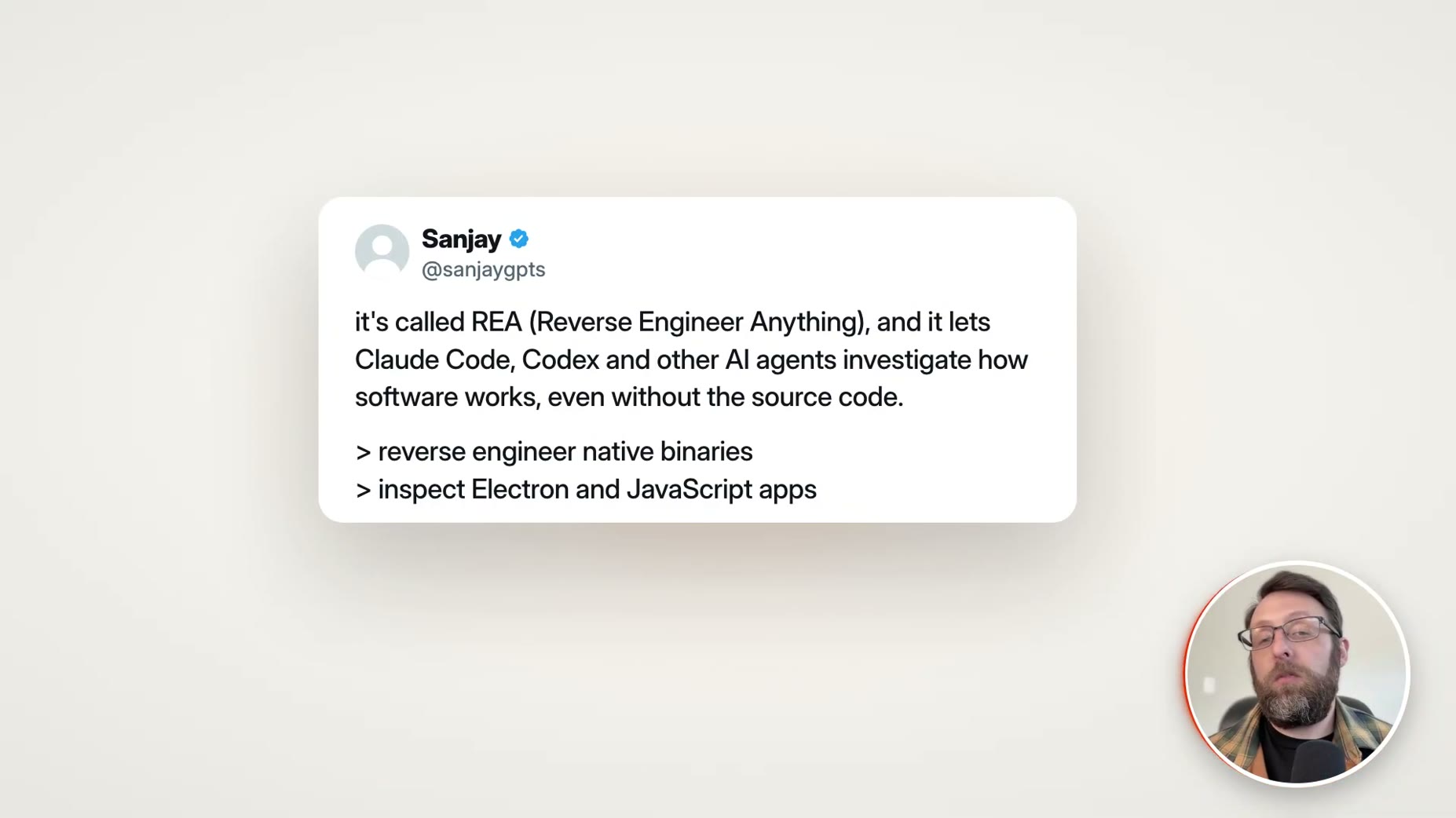
- Sourced claim (00:52): A post on X described REA as letting Claude Code, Codex, and other AI agents investigate how software works without source code, including reverse engineering native binaries and inspecting Electron/JavaScript apps.
- Sourced claim (04:41): Developer Mukesh Murugan pointed REA at the color picker in Microsoft PowerToys.
- Sourced claim (04:50): Murugan gave Claude only the finished app, not the code, and checked REA's answers against Microsoft's public PowerToys source.
- Sourced claim (05:00): REA got 8 of 9 findings fully right, matching specific files and line numbers including dllmain.cpp:115-125 and MouseInfoProvider.cs:104-114.
- Sourced claim (05:03): Murugan then used REA's findings to build his own color picker in under 750 lines of C# code, comments included.
- Sourced claim (05:08): A developer used REA on DX-Ball, a 1990s brick breaker game, to find the exact math moving sound between speakers as the ball moves.
- Sourced claim (05:25): The rebuilt sound math matched the original in all 3,205 tests, with 63 of 63 compiled bytes identical.
- Sourced claim (05:39): A third developer pointed REA at a QuickBooks Desktop for Mac 2024 trial (version 23.1.13.962 R14) and built an open source accounting app called Ledger Reborn.
- Sourced claim (06:22): Ledger Reborn's downloads grew from about 100 a week in September to 128,470 in the Oct 6-12 week.
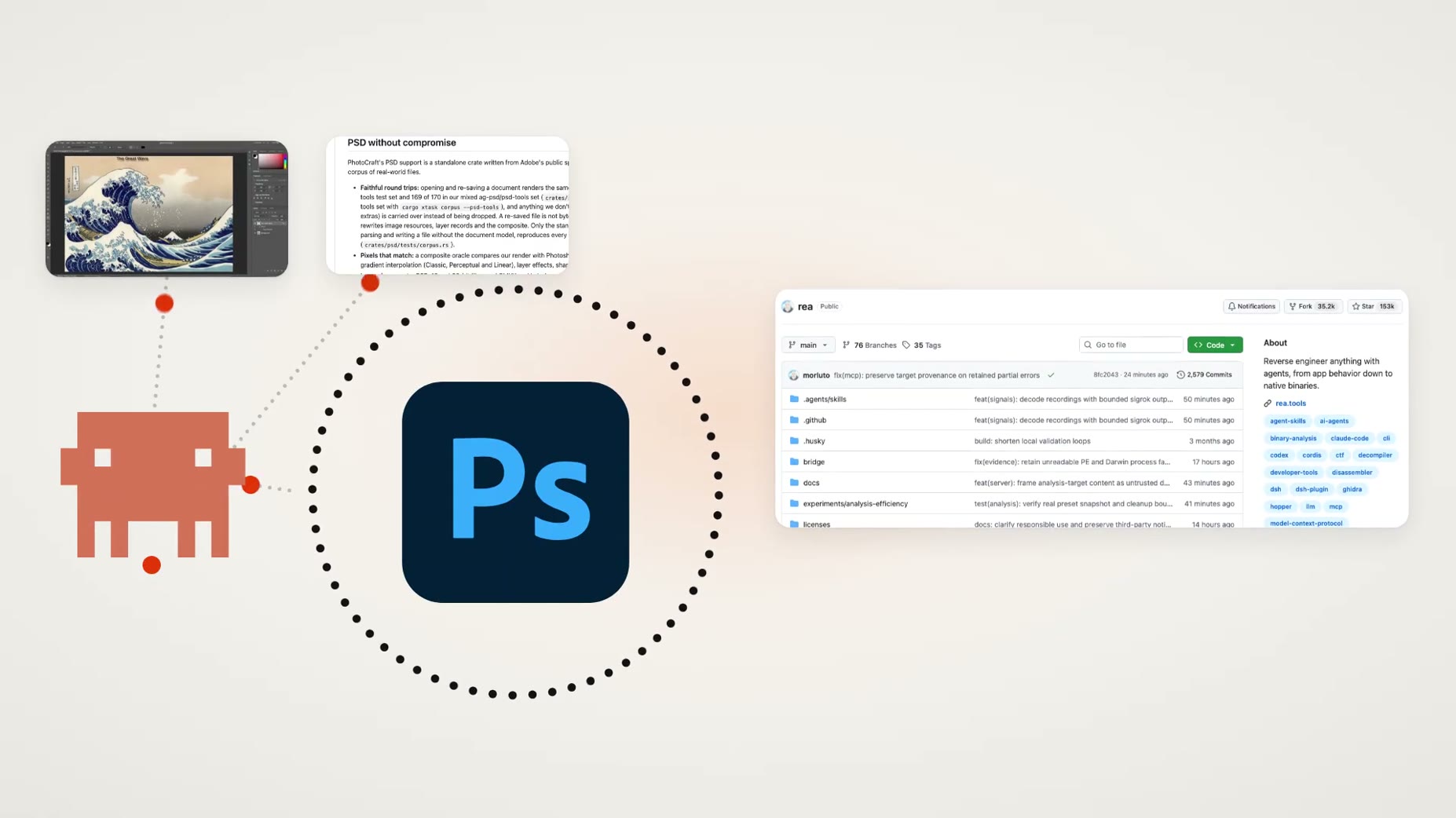
- Sourced claim (08:28): Engineer Brandon Thomas used Claude to build free open source copies of seven Adobe apps, including Photoshop, Premiere, and Lightroom, under the project ArtCraft.
- Sourced claim (08:36): ArtCraft's Photoshop copy, PhotoCraft, got over 24,000 GitHub stars in eight days, built from public documents and study of Adobe's behavior without touching Adobe's code.
- Sourced claim (09:02): PhotoCraft's PSD support is a standalone crate written from Adobe's public corpus of real-world files.
- Sourced claim (09:04): PhotoCraft's PSD round-trip test passes 169 of 170 files in the mixed ag-psd/psd-tools test set, run via cargo xtask corpus.
- Sourced claim (09:02): A composite oracle compares PhotoCraft's render against Photoshop's, checking gradient interpolation modes and layer effects.
- Sourced claim (09:17): ArtCraft's own team says their Photoshop copy is not yet ready for daily professional work.
- Unsourced claim (00:18): REA has over 149,000 stars on GitHub.
- Unsourced claim (00:23): REA is six months old, and for almost all of that time nobody paid attention to it.
- Unsourced claim (00:27): The creator says REA had about 13,000 stars last Wednesday and 149,000 five days later, with no source given for the figures.
- Unsourced claim (09:17): The creator asserts the cost of copying an app keeps dropping, with no source given.
- Unsourced claim (12:34): The creator asserts that results, support, trust, and the ability to win customers are all getting more valuable every month, with no source given.
- Anecdote (02:10): The host says he co-founded the Claude Code Club, a $9/month community.
- Anecdote (09:36): The creator states the Claude Code Club has over 8,000 members with a 4.9-star rating across 120 reviews, a self-reported figure about his own product.
- Anecdote (09:48): A marketing-style testimonial from member Glenn Davis, a 5-star review saying he has been a paying member for 4 months, appears mixed into the evidence.
- Anecdote (12:13): The speaker says he spends time on YouTube and in the Club and almost no time worrying about someone copying his stuff.
- Anecdote (12:20): The speaker says someone could copy every lesson in the Club tomorrow but can't copy the 8,000 people in the Club who already know him.
- Prediction (09:17, no timeframe stated): the cost of copying an app keeps dropping.
- Prediction (12:34, no timeframe stated beyond 'every month'): results, support, trust, and the ability to get traffic and win customers will keep getting more valuable.
- Ask (02:57): Install REA by pasting the GitHub link github.com/morluto/rea into Claude Code, saying 'install this for me,' then restarting Claude Code.
- Ask (13:46): The creator pitches the Claude Code Club, a step-by-step path to master Claude Code in 45 days for $9 a month.
- Counterpoint (07:01): REA's makers say they won't help users break copy protection, build game cheats, or copy someone else's paid software.
- Counterpoint (07:20): Reverse engineering an app can break its license agreement depending on where you live, and the presenter notes he isn't a lawyer.
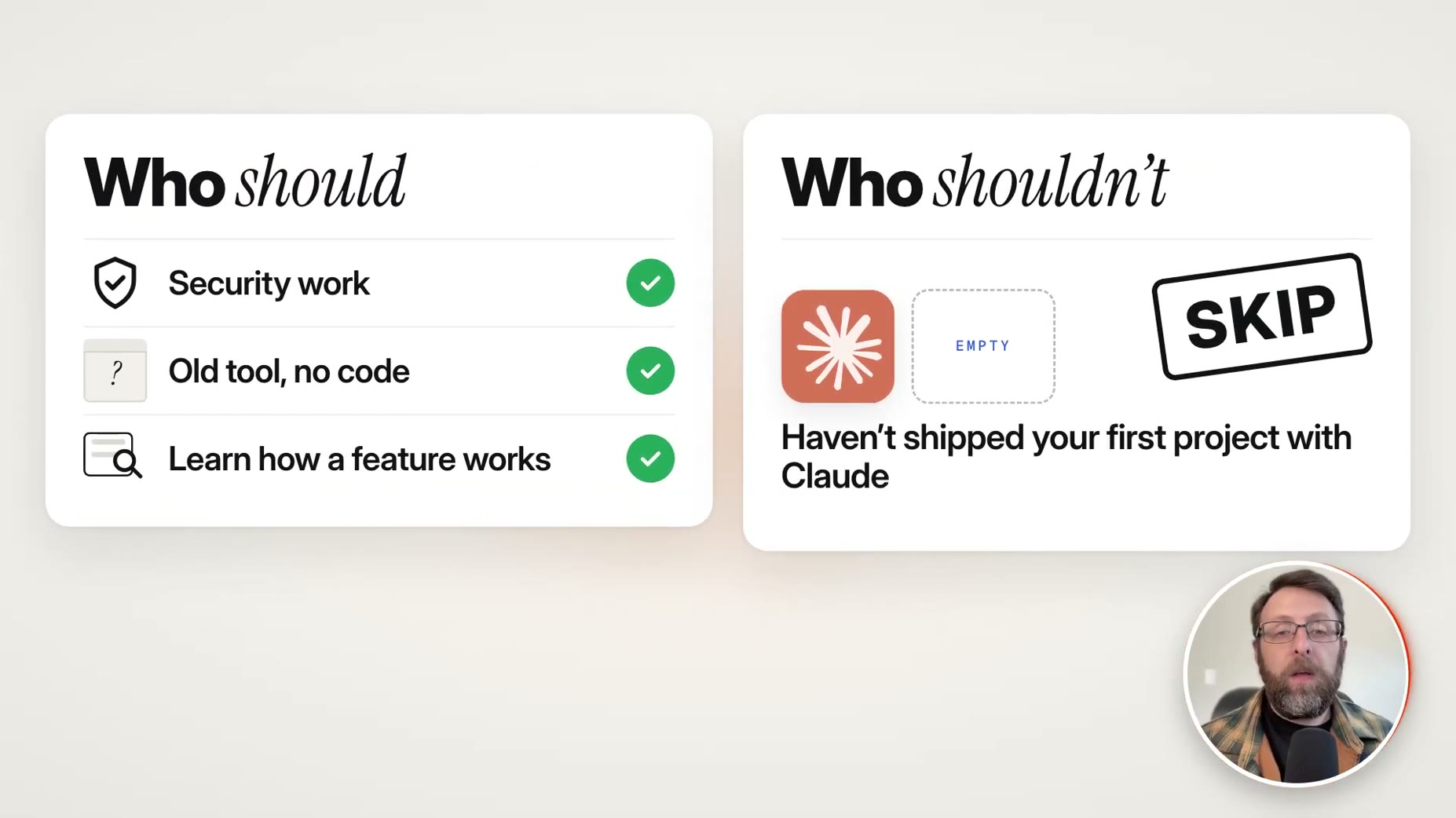
- Counterpoint (07:30): The presenter says security workers, companies with old tools and no source code, and people learning how a feature works should use REA, while beginners who haven't shipped a first project with Claude should skip it.
install this for me github.com/morluto/rea
github.com/morluto/rea What does this repo do, and how could I use [...]
Understand how search works in the Notes app, show me the evidence, and build a similar feature for my project.
function onPercent() { const a = first; return a + a * p / 100; [...]How this brief was shaped: Trend Commentary / Opinion Essay · confidence Low
The transcript frames a viral GitHub repo (REA) with a star-count timeline, a quoted X post, and an explicit thesis question about what people will pay for if apps can be copied, which is a trend/opinion spine, while the later OCR shows a genuine teardown table mapping PowerToys functions to dllmain.cpp lines, a distinct architecture-mapping demo embedded inside the commentary.
The lens sets this brief's structure, never its facts — every claim is held to the same citation and fact-check standard.