How America Saved the Yen (for now)
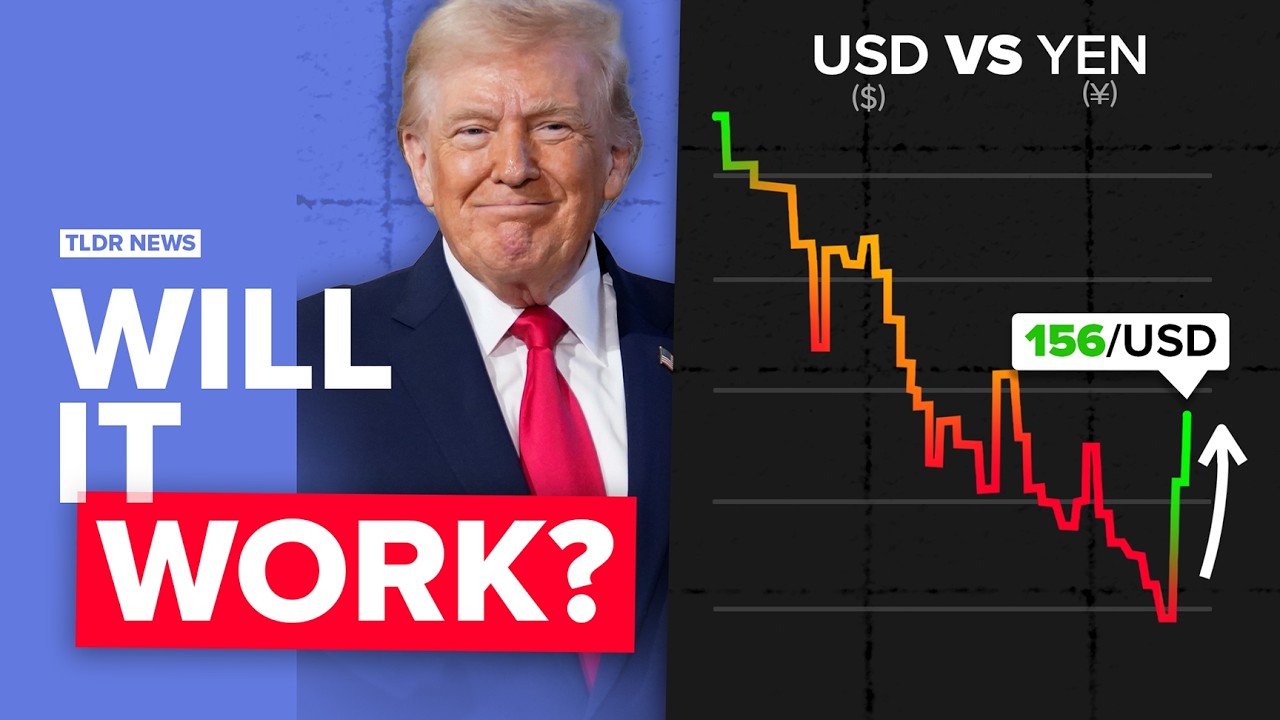
The US Treasury intervened in the foreign currency market on Friday to support Japan's yen, days after Treasury Secretary Scott Bessent called it 'very undervalued' and 'very cheap' [00:00], and the video reports this was the first US-Japan joint currency intervention since 1998, per a report dated 3 Aug 2026 [02:54]. The yen, which had slid to about 164 to the dollar last week [01:17], rose back below 160 by Friday and held there Monday [03:10], against a backdrop of Japan's high debt burden making interest-rate hikes to fight inflation costly [02:12][02:36]. In the creator's view, the intervention fits a broader pattern of the Trump administration using America's financial heft to intervene in other countries' politics, pointing to prior support for Argentina's peso and Viktor Orban's government [05:19][05:27], and they argue there are reasons to be skeptical the yen's rebound holds, since Japan's own reluctance to defend its currency and the US's choice to use euros instead of dollars suggest the support is conditional [06:04][06:31].
Confirmed: [00:00] US Treasury intervened in the foreign currency market Friday to support the yen, days after Treasury Secretary Scott Bessent called it 'very undervalued' and 'very cheap.'
- Confirmed: [00:52] the yen traded around 110 to the dollar in the late 2010s, slipped to about 150 in 2022, then hovered near 160 for a couple of years as Japan intervened to slow the decline.
- Confirmed: [01:17] after months of downward pressure and costly but futile interventions, the yen slipped past 160, hitting a low of about 164 last week.
- Confirmed: [01:30] Japan's inflation has run hot since 2022, a likely factor eroding the yen's value and its appeal as a safe-haven currency.
- Confirmed: [02:12][02:36] raising interest rates is difficult for Japan because it would dramatically increase government debt-servicing costs given Japan's massive debt burden relative to other G7 countries.
+ 16 more takeaways
- Confirmed: [02:42] Japanese bond yields are already surging while the current government has signaled intent to spend heavily.
- Confirmed: [02:59] the US used euros, not dollars, to buy up yen on the international market.
- Confirmed: [03:10] the yen rose from about 164 to the dollar to below 160 by Friday and held there on Monday.
- Confirmed: [03:19] earlier this year the New York Federal Reserve performed a rare 'rate check' with foreign currency traders on yen pricing, widely seen as a signal of upcoming intervention.
- Source cited: [02:54] not stated - the video reports the operation was the first joint US-Japan currency intervention since 1998, per a report dated 3 Aug 2026.
- Source cited: [04:23] Trump quoted saying 'We have a good relationship with Japan... they have a weakening yen, and they wanted a little bit of help, and we're always there for Japan,' adding Japan has been good to the US 'with the exception, of course, of Pearl Harbor.'
- Confirmed: [05:27] the Treasury also propped up the Argentinian peso last year and offered support to Viktor Orban's government, with Bessent announcing a $20bn currency swap framework with Argentina's central bank.
- Take (creator): [05:19] the intervention fits a pattern of the Trump administration using America's financial heft to intervene in other countries' politics.
- Take (creator): [05:37] whether the intervention works depends on credibility, meaning whether traders believe the US will keep burning through reserves to defend the yen.
- Take (creator): [06:04] the fact that the US intervened suggests Japan lacks the stomach to protect the yen on its own despite sitting on massive foreign-asset reserves.
- Take (creator): [06:31] using euros instead of dollars suggests the US's support for the yen is conditional.
- Take (creator): [06:38] no one is entirely sure why the Treasury used euros instead of dollars, but the creator suggests it is probably partly optics, since the Trump administration doesn't want to be seen giving dollars to Japan.
- Open question: [06:38] why the Treasury chose euros over dollars is not confirmed in the video.
- Confirmed: [07:41] per the magazine issue's article 'Can Germany Defend Europe?', Germany was Europe's largest military spender in 2025, with spending growing 24% year-on-year to $114bn.
- Confirmed: [07:53] the outlet is launching a new business section alongside the relaunch of the TLDR Business YouTube channel later this month.
- Confirmed: [08:19] a bundle subscription combining Too Long and TLDR Party is offered at £8.19 print (was £13.99) and £4.99 digital (was £9.99), with subscribers getting 20% off and an extra £3 off the first copy via promo code AUGUST26.
How this brief was shaped: News Analysis / Commentary · confidence Medium
Transcript opens with a specific confirmed event (US Treasury intervening to support the yen, with a Besant quote and a Reuters photo) then states the video will explain why it happened and why it could backfire, and OCR shows multiple contemporaneous news headlines plus a USD/JPY chart backing the factual layer, while the mid-section pivots into the creator's own mechanism-level explanation of interest rates and inflation.
The lens sets this brief's structure, never its facts — every claim is held to the same citation and fact-check standard.