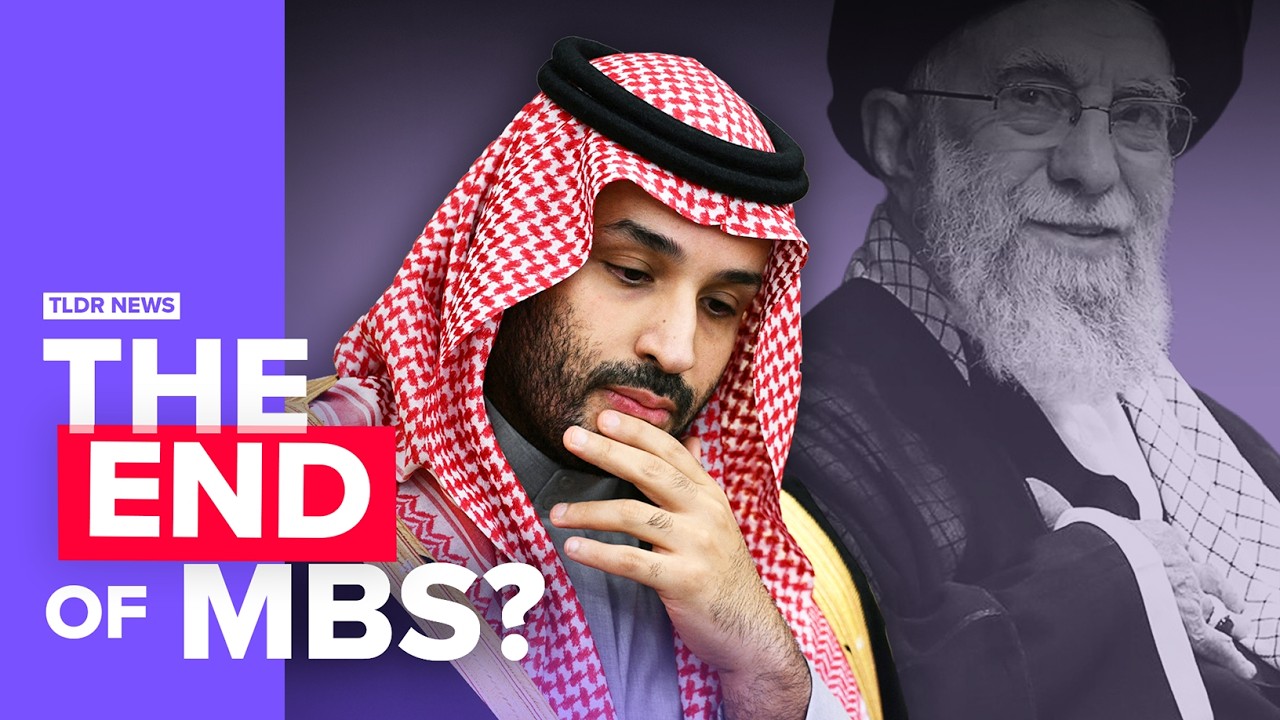
Is This the Beginning of the End for MBS?
This TLDR News video, hosted by Ben Blissett, examines whether Saudi Crown Prince Mohammed bin Salman (MBS) is entering a period of serious political trouble, framing its central question at 00:49 as whether current events mark the beginning of the end for him, posed as an open question rather than a stated conclusion. The host traces Saudi Arabia's historical balance of power between the royal family and the religious establishment known as the ulama, from the 1920s Ikhwan revolt through the 1979 Grand Mosque siege, to argue MBS's consolidation of near-total authority broke an earlier arrangement with the ulama. The video's center of gravity is a tension between MBS's current inability to deliver on his promised prosperity and security, evidenced by the restarted Houthi conflict and economic strain, and the host's own observation that no direct challenge to MBS's rule appears imminent given his tight grip on state security. The host does not resolve whether this amounts to an actual turning point for MBS, leaving the trajectory open.
[00:49] The host frames the video's central question as whether current events mark the beginning of the end for Saudi Crown Prince Mohammed bin Salman (MBS), presented as an open question rather than a confirmed conclusion.
- [00:06] The host states the long-running conflict with the Houthis has restarted and the Strait of Hormuz has effectively been shut again.
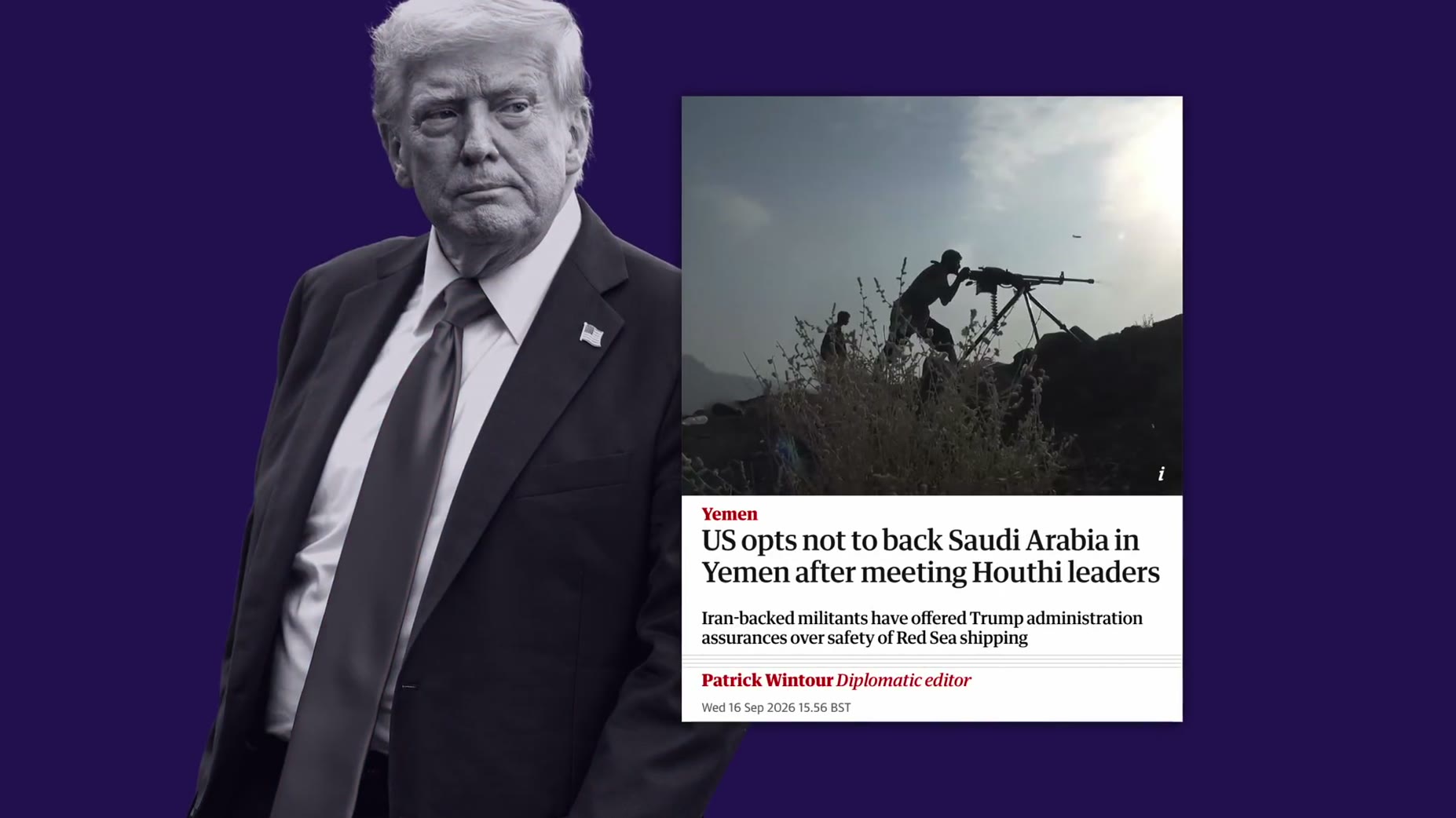
- [00:16] The host states US President Donald Trump has refused to help Saudi Arabia.
- [00:18] The host states the US declined to back Saudi Arabia in Yemen after meeting Houthi leaders, who offered assurances about the safety of Red Sea shipping.
- [00:18] The host states the Mecca alliance has proved to be little more than a damp squib, with both Pakistan and Turkey refusing to get directly involved.
+ 30 more takeaways
- [00:26] The host states MBS has apparently had to ask the UK for help.
- [01:13] The host explains Saudi politics has long been defined by a balancing act between the Saudi royal family and the religious elite known today as the ulama.
- [01:23] The host explains this dynamic began at least in the 1920s when King Abdulaziz, founder of the modern Saudi state, allied with the Ikhwan, a tribal religious Sunni Islamist militia, to conquer the Arabian Peninsula.
- [01:56] The host explains that in 1929 the Ikhwan turned on Abdulaziz after he introduced Western technologies like the telegraph and cars, normalized relations with non-Muslim states including Britain, and told the Ikhwan to stop invading neighboring kingdoms.
- [02:11] The host states Abdulaziz prevailed partly by borrowing machine guns from Britain, and afterward delegated more power to the ulama to ease religious tension.
- [02:24] The host states that in 1979 Islamist militants seized the Grand Mosque and denounced the monarchy as corrupt, in a siege that lasted roughly two weeks before the mosque was retaken.
- [02:33] The host states that siege, combined with the Iranian revolution next door, pushed the monarchy to reverse 1970s reforms and align more closely with the ulama throughout the 1980s.
- [02:49] The host states MBS, rising to power from 2015, upended this balance by consolidating almost all authority in the monarchy and himself, neutering the religious police, jailing more radical clerics, and promoting Saudi nationalism over the ulama's transnational Islamic identity.
- [03:30] The host argues MBS got away with curbing the ulama due to his near-total control of security services, divisions within the ulama, and the ulama's discrediting from the 2000s al-Qaeda insurgency, the Arab Spring's aftermath, and association with the Muslim Brotherhood.
- [03:54] The host states MBS's basic pitch was prosperity and security in exchange for political and religious quiescence, which was attractive to much of the Saudi public, especially younger generations.
- [04:06] The host argues recent events have undermined this implicit contract between MBS and the Saudi public.
- [04:13] The host argues MBS can currently guarantee neither prosperity nor security, a claim the host supports with the specific evidence that follows.
- [04:16] The host cites Vision 2030 being constantly pared back as evidence Saudi Arabia's prosperity promise is faltering.
- [04:16] The host cites large and growing state budget deficits as further evidence of this.
- [04:16] The host cites recent strikes in Riyadh and elsewhere as evidence that Saudi Arabia is no safer than the rest of the Middle East.
- [04:28] The host argues recent religious tumult across the Middle East has foregrounded religious identities, which the host says worsens matters for MBS.
- [04:43] The host notes the Saudi rivalry with Iran is often framed as a Sunni-Shia conflict, including by the Saudi royals themselves, and says even the US has leaned into Christian nationalist themes.
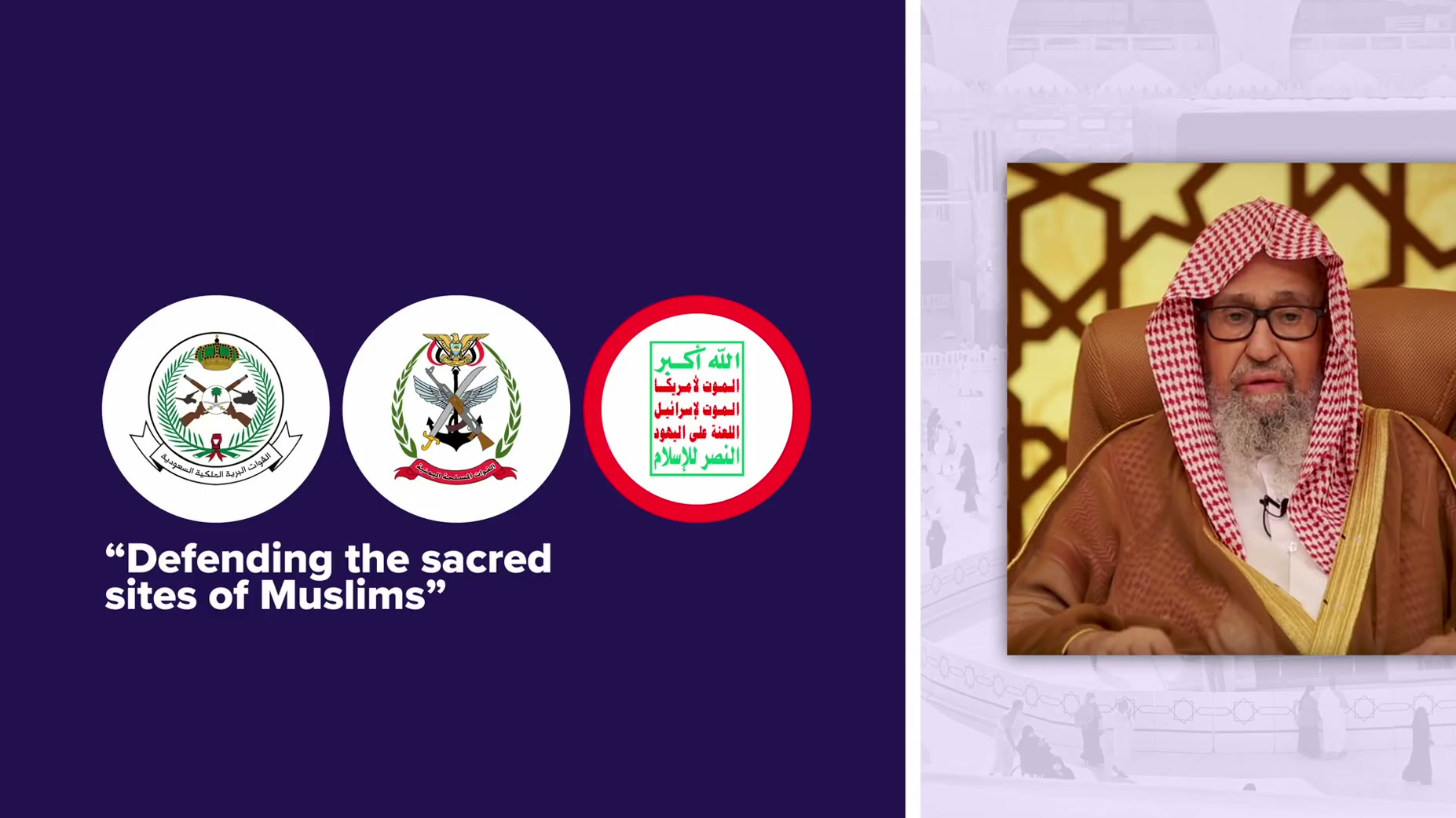
- [04:59] The host reports that on September 24th the Grand Mufti, Saudi Arabia's highest-ranking cleric, gave an address to Saudi and Yemeni government forces, presumably with MBS's sign-off, framing the war against the Houthis in aggressively religious terms.
- [04:59] According to the host's account, the Grand Mufti told troops they were defending the sacred sites of Muslims.
- [04:59] According to the host's account, the Grand Mufti described the Houthis as a misguided sect and deviant group.
- [05:59] The host argues this sectarian framing risks alienating allies like Pakistan and Turkey, noting the anti-Houthi coalition is not exclusively Sunni and the Houthis themselves are not straightforwardly Shia.
- The host argues these religious identity appeals risk revitalizing the ulama as a distinct political power center and restoring their historical check on royal power, which threatens MBS given his preference for absolute authority and imperfect religious credentials (timestamp not stated in the extracted points).
- The host argues it is hard to see a direct challenge to MBS emerging in the immediate future, given his near-monopoly on state authority and the security services (timestamp not stated in the extracted points).
- The host notes Saudi Arabia is now a more ideologically moderate place than before, which might give the ulama less sway, offered as a complicating factor rather than a resolved conclusion (timestamp not stated in the extracted points).
- The host argues that if current trends continue, a challenge to MBS could emerge, especially if he is cornered into accepting support from Israel (timestamp not stated in the extracted points).
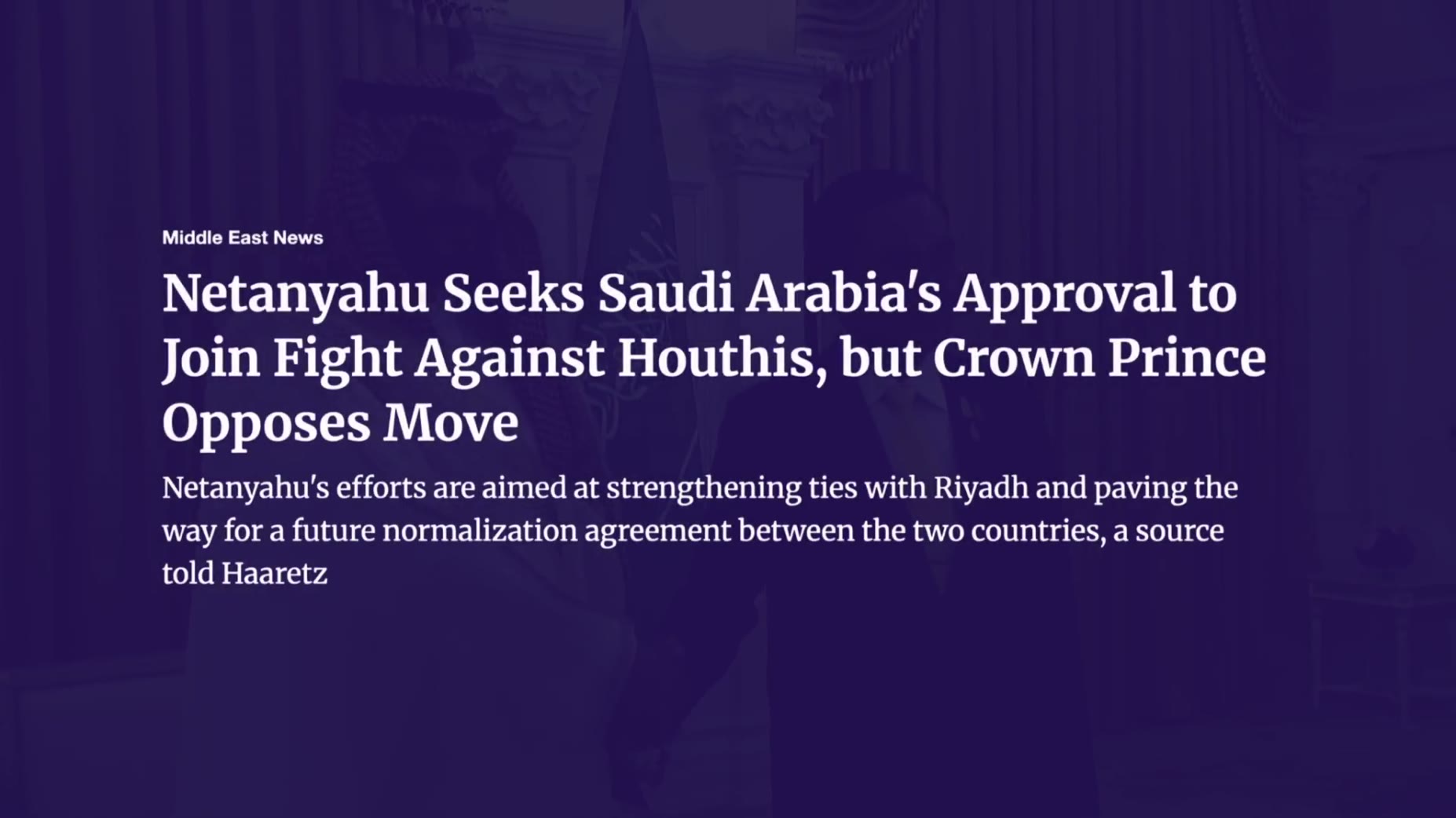
- [07:11] The host cites a Haaretz-sourced report stating Netanyahu is seeking Saudi approval to join the fight against the Houthis, but that the Crown Prince opposes the move, as part of efforts toward a future normalization agreement.
- The host argues MBS is reaping what he sowed, reasoning that making himself supreme leader means taking all the credit when things go well but also all the blame when things fall apart (timestamp not stated in the extracted points).
- [07:19] On-screen visuals show Trump with MBS and Saudi officials at a reception hall photo-op and in an Oval Office meeting with a model of Air Force One present.
- The host's analysis contains an internal tension: the video raises the possibility that this is the beginning of the end for MBS while also stating a direct challenge to his rule is hard to foresee in the near term given his control of security services.
- No verbatim quotations from the host or the Grand Mufti are available; the extracted points provide paraphrased claims rather than exact transcript wording, so quotable exact quotes are not stated.
How this brief was shaped: Discourse (interview / podcast / video essay) · confidence Low
margin rule: 'news_analysis' 0.62 vs 'discourse' 0.55 (margin 0.07 < 0.08) -> demoted to 'discourse'. The opening lays out confirmed current events, the Houthi conflict restarting, the Strait of Hormuz shut, allies refusing to help, then pivots into the creator's own thesis that this could be the beginning of the end for MBS, which is classic fact-versus-take structure. The middle slice shifts into historical narration of the Ikhwan revolt and 1979 Grand Mosque siege used as supporting evidence for that argument, and the OCR is dominated by the channel's standard sponsor firewall manifesto rather than content-specific visuals.
The lens sets this brief's structure, never its facts — every claim is held to the same citation and fact-check standard.