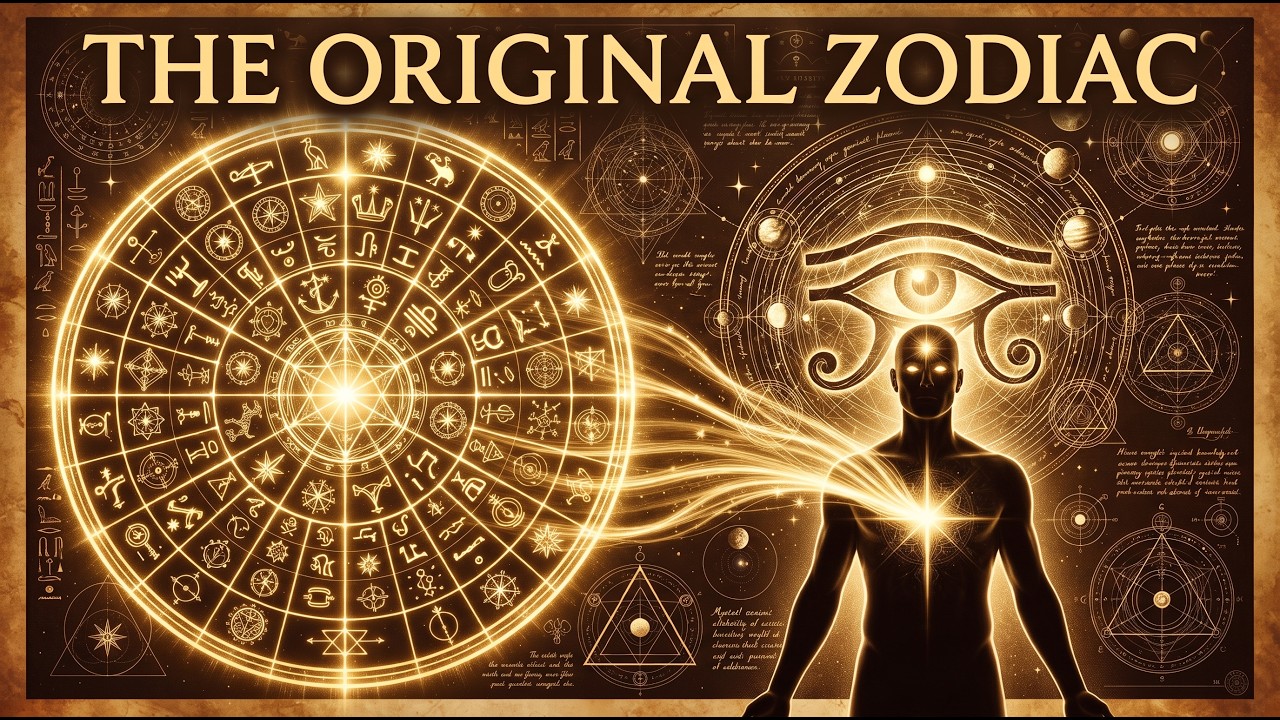
The Egyptian Decans: The Original 36 Zodiac Signs
This is a narrated video essay (no host or guest, identities not stated) whose subject is the ancient Egyptian Decans, the 36 star groups used to mark 10-day periods and track night hours. The narrator's central argument is that decans, which historians and archaeologists describe as astronomical calendar markers, may have also functioned as a spiritual system, a 'map of initiation' tracking stages of consciousness, though the narrator repeatedly flags that this reframing is speculative and not explicitly supported by the earliest Egyptian sources. The piece traces how later Hellenistic astrologers and Hermetic writers in Alexandria layered psychological and archetypal meaning onto the decans centuries after their original astronomical use, and closes with practical meditation and journaling exercises inspired by that layered symbolism.
The video's core subject is the 36 Egyptian Decans, star groups that historians and archaeologists describe as astronomical markers used to divide the year into 36 ten-day intervals and track the hours of the night.
- The narrator poses the video's central question at [00:00:01]: 'what if everything you've been told about the zodiac began with only half the story,' framing the decans as more than a timekeeping system.
- The narrator proposes, stated without evidence given beyond this framing, that the decans 'may have been a map of initiation, a forgotten spiritual technology guiding the soul through cycles of transformation' [00:01:05].
- The narrator explains that modern scholars derive the term 'decan' from the Greek 'decanos' (group of ten), because each decan corresponded to a roughly ten-day period in the Egyptian civil calendar [00:05:05].
- The narrator explicitly distinguishes historical evidence from later interpretation, stating that 'ancient texts do not describe the Decans as a complete personality system like many modern astrological traditions do' and that they 'appear primarily as astronomical and ritual markers' [00:06:32]-[00:06:41].
+ 9 more takeaways
- The narrator states that after Alexander the Great's conquest of Egypt, in the 'intellectual melting pot of Alexandria,' Egyptian star lore merged with Babylonian astrology, Greek philosophy, and Hermetic teachings, and it was this later synthesis, not the original Egyptian system, that attached psychological and archetypal qualities to each decan [00:07:28]-[00:08:08].
- The narrator notes that surviving Hermetic writings attributed to Hermes Trismegistus were composed during the Hellenistic and Roman periods rather than the age of the pyramids, though they drew heavily on Egyptian religious concepts [00:08:43].
- The narrator states that whether the 36 decans were intentionally linked to formal initiatory stages 'remains a matter of scholarly debate' and that 'ancient Egyptian sources do not explicitly present the Decans as a formal ladder of spiritual initiation in the way some modern esoteric writers suggest,' explicitly leaving this tension unresolved.
- The narrator ties the decans to the Egyptian concept of Maat, described as truth, harmony, justice, and cosmic balance, stating that the movement of the stars was considered a visible expression of this divine order [00:06:08]-[00:06:29].
- The narrator delivers the quotable line 'a subtle shift changes everything' at [00:11:45] while contrasting the fixed-identity language of modern zodiac ('I am a Leo') with a more dynamic decanic view of the self.
- The narrator states the quotable sequence 'a star was never just a star,' 'a lion was never simply an animal,' and 'a serpent was never merely a reptile' at [00:12:59]-[00:13:05], arguing ancient symbols pointed beyond their literal meaning.
- The narrator offers a sailor-and-wind analogy, stating 'the stars in this analogy are not the captains of the ship, they are the weather,' to argue the decans illuminate patterns rather than dictate fixed destiny [00:20:30]-[00:20:34].
- The narrator explicitly warns viewers, stated without external evidence beyond the narrator's own reasoning, 'do not become obsessed with the map,' cautioning that symbolic systems like astrology become 'dangerous when we mistake them for reality itself' [00:29:02]-[00:29:13].
- The narrator closes by proposing several practical exercises inspired by the decans, including 10-day journaling cycles, a 36-part reflection on qualities like courage and patience, and unaided night-sky observation, each explicitly framed as symbolic practice rather than documented ancient Egyptian ritual [00:26:39]-[00:34:56].
How this brief was shaped: Discourse (interview / podcast / video essay) · confidence Low
A single narrator builds a thesis around the Egyptian Deccans, repeatedly asking what if the accepted historical explanation is incomplete and reframing them as a forgotten spiritual technology, which is an interpretive argument rather than neutral instruction. OCR shows decorative As Above So Below and Hermes Trismegistus overlay text with numerology scribbles, supporting a mystical interpretive angle rather than a teaching or procedural one.
The lens sets this brief's structure, never its facts — every claim is held to the same citation and fact-check standard.